Guide · Comparison
Proforma invoice vs invoice: what actually changes
They look alike, carry the same lines and often the same amounts. But one is an offer and the other is a claim for payment, and that difference decides who owes what, when tax becomes due and which document your accountant can use.
Updated 17 October 2026 · 3 min read
The short answer
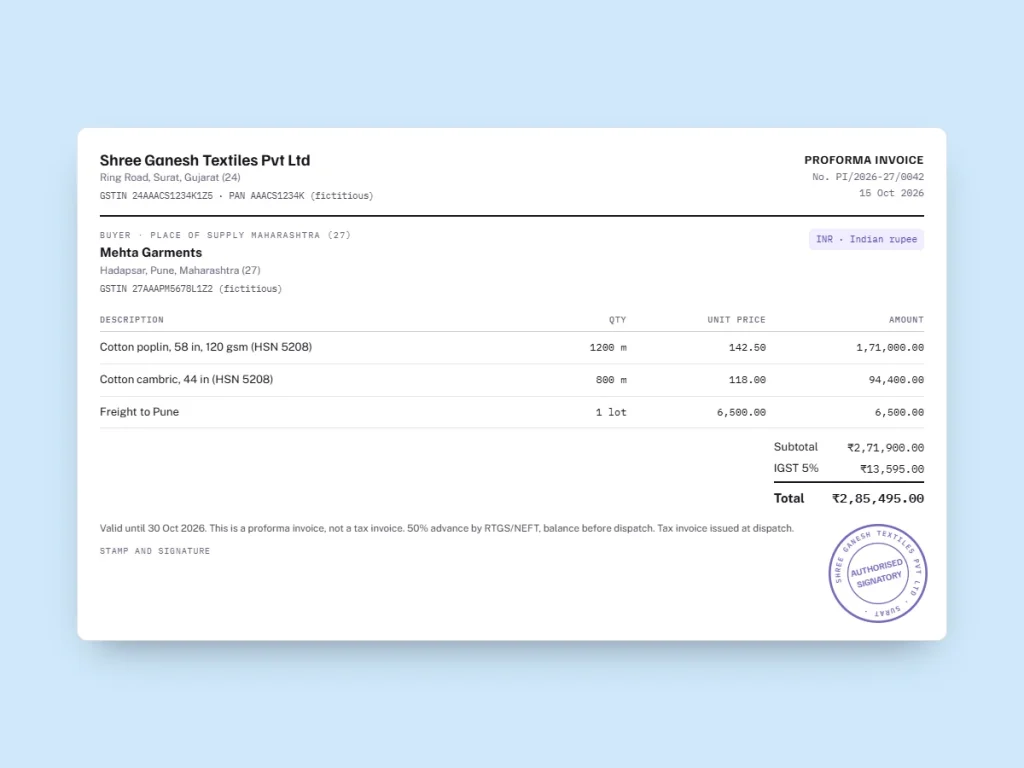
A proforma invoice is a priced offer sent before the sale; an invoice (also called a final, commercial or tax invoice) records the sale after it and asks for payment. Only the invoice creates a debt, goes into the accounts and triggers VAT or GST.
From the guide to the document
Your proforma with these details, ready as a PDF.
The difference in one table
| Proforma invoice | Invoice | |
|---|---|---|
| Purpose | Tell the buyer exactly what they will get and what it will cost | Record a sale and ask for payment |
| When | Before the order, the deposit or the shipment | When the goods are delivered or the service is done |
| Legal effect | An offer; it binds you once the buyer accepts it | Evidence of a debt the buyer must pay |
| Tax | No VAT or GST becomes due because you issued it | Triggers VAT or GST where the seller is registered |
| Accounting | Not recorded as a sale | Recorded in the sales ledger |
| Numbering | Its own series, for example PI-2026-042 | The legal, unbroken invoice series |
| Buyer can reclaim tax on it | No | Yes, if it meets the tax invoice rules |
| Who reads it | The buyer, their bank, a licensing office, a forwarder | The buyer’s accounts team, the tax authority, customs |
| Electronic invoicing systems | Not concerned | Concerned where they apply (India, Kenya and others) |
The two documents are not alternatives. In most sales they follow each other: the proforma fixes the deal, the invoice records it once it happens.
When each document is issued
A typical sale between two businesses runs in this order:
- Enquiry and quotation. The buyer asks for a price; you answer with a quotation. See proforma invoice vs quotation.
- Proforma invoice. The buyer is ready to commit, or needs a formal document for a bank, an import licence or an internal approval. You send the proforma with the final lines, the currency, the delivery terms and a validity date.
- Order or deposit. The buyer signs the proforma, sends a purchase order or pays the advance it requests.
- Delivery. The goods leave with a delivery note, or the service is performed.
- Invoice. You issue the invoice, numbered in your invoice series, with the tax the law requires.
- Receipt. When the money arrives, you confirm it with a receipt.
If the deal falls through after step 2, nothing needs to be cancelled in your accounts: the proforma simply expires on its validity date.
Proforma invoice vs tax invoice
In countries with VAT or GST, “tax invoice” is a defined document: the law lists what it must contain and when it must be issued, and only a valid tax invoice lets the buyer claim back the tax. A proforma does not have to meet those rules, and it cannot replace them.
- India. Section 31 of the CGST Act sets out when a tax invoice must be issued, and the CGST Rules list its particulars. A proforma is a commercial document outside that framework: no GST becomes due because of it, and the buyer cannot claim input tax credit on it. Details on our India page.
- Kenya. Tax invoices must go through the KRA’s eTIMS system. A proforma is not a tax invoice and does not go through eTIMS. See proforma invoice in Kenya.
- Nigeria. VAT is charged at 7.5% on the VAT invoice; the proforma only shows the VAT the buyer will pay. See proforma invoice in Nigeria.
A simple line avoids any confusion: “This is a proforma invoice, not a tax invoice.”
Electronic invoicing applies to invoices, not proformas
More and more countries require invoices to be reported to the tax authority in real time: India’s e-invoicing system for businesses above ₹5 crore of turnover, Kenya’s eTIMS, and similar systems elsewhere. These rules target the tax invoice. A proforma, a quotation or a delivery note stays an ordinary document, usually a PDF.
InvoiceProforma produces PDF documents and is not connected to any e-invoicing system. If your invoices must go through one, keep using it for the invoice itself, and use the proforma for everything that happens before.
Turning the proforma into the invoice
When the buyer accepts, the invoice should repeat the proforma: same buyer, same lines, same prices, same currency, same terms. Differences are where disputes and bank refusals start. What changes:
- the title, from “Proforma invoice” to “Invoice” or “Tax invoice”;
- the number, taken from your invoice series, never from the proforma series;
- the date, which becomes the invoice date;
- the tax, now actually charged where you are registered;
- any advance already paid, deducted from the amount due.
In InvoiceProforma, one click turns an accepted proforma into an invoice with the same lines and currency, numbered in your invoice series. Payments recorded as receipts then show on the invoice as paid, with the balance due.
Five common mistakes
- Numbering the proforma in the invoice series. It leaves a gap or a phantom sale in your records.
- Forgetting to issue the invoice after a deposit. The buyer has paid against an offer; your accounts still show nothing.
- Changing the description between the two documents. Banks and customs compare them line by line.
- Treating the proforma total as tax already charged. The tax on a proforma is for information; it is due on the invoice.
- Leaving out the validity date. Without it, a buyer may come back months later expecting the same price.
Free template
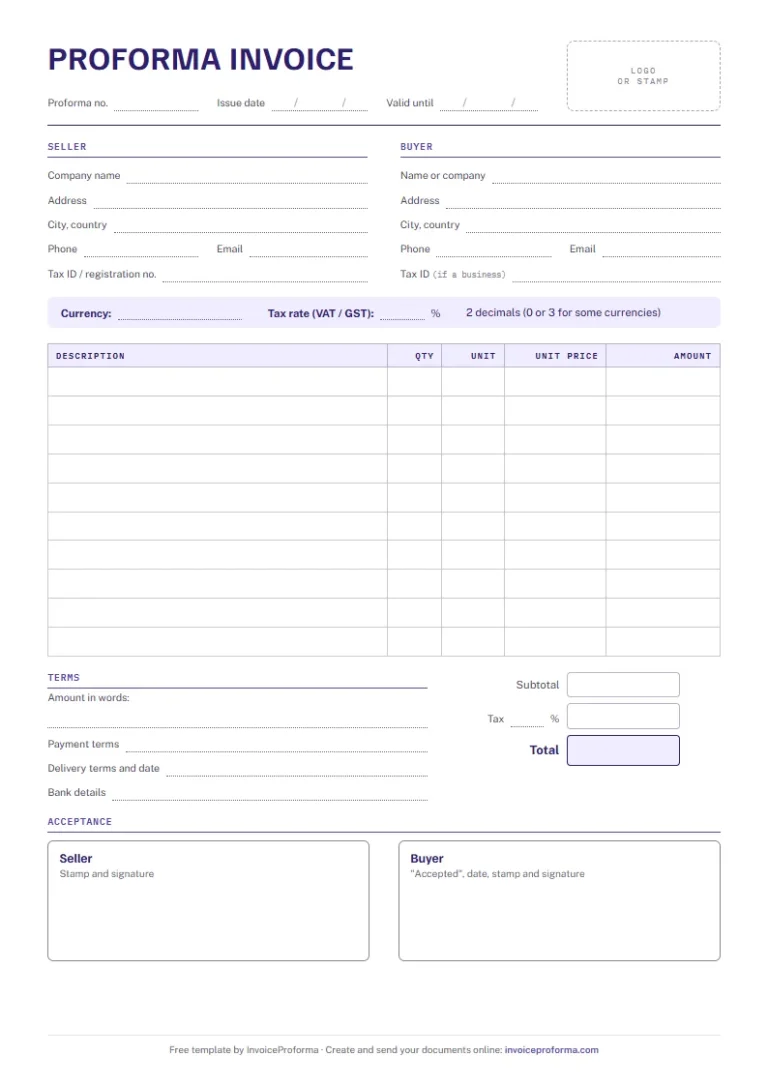
Simple proforma invoice template
Seller, buyer, lines, tax, total, amount in words, payment and delivery terms, bank details and acceptance. A4, free, no sign-up.
Questions
Proforma Invoice vs Invoice: your questions
Can a buyer pay against a proforma invoice?
Yes. Many buyers pay a deposit, or the full amount, on the basis of a proforma. The seller then issues the invoice and a receipt. The proforma itself never becomes the accounting document.
Can a proforma invoice replace an invoice?
No. The invoice records the sale and, where VAT or GST applies, it is the document the tax rules require. A proforma only describes the offer.
Is a proforma invoice a tax invoice?
No. It does not need to meet the tax invoice rules, no tax becomes due because of it, and the buyer cannot use it to reclaim VAT or GST.
Should I record a proforma invoice in my accounts?
No. Keep it on file with the order, but it is not a sale. Record the invoice when it is issued, and any advance when it is received.
Do I have to cancel a proforma that was not accepted?
No. It lapses on its validity date. Mark it as cancelled in your own records if you want to keep them tidy.
Sources and updates
Checked on 17 October 2026. Tax and customs rules change: for your own case, confirm with the authority concerned, your bank or a tax adviser.
Read next
Related guides
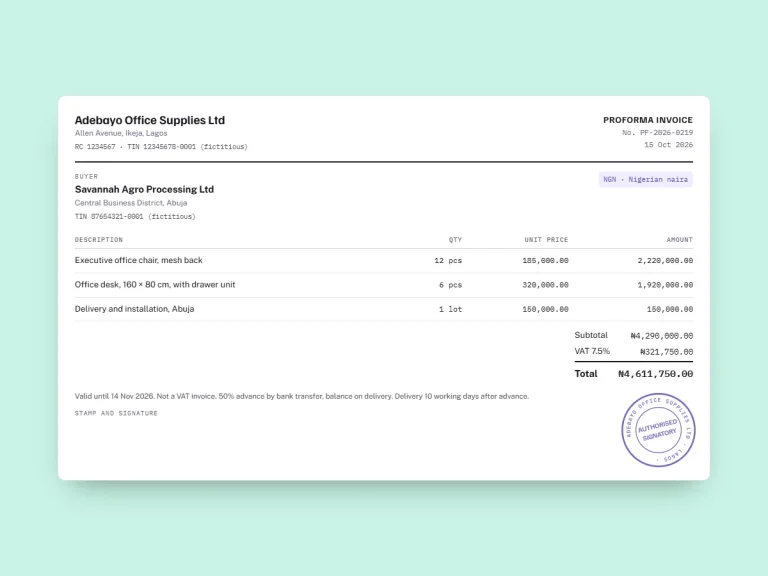
Quotation or proforma invoice? What each one commits you to, what buyers and banks expect, and when to send one after the other. With a comparison table.
Which document does customs need, and which does the bank? A field-by-field comparison of proforma and commercial invoices, and errors that delay shipments.
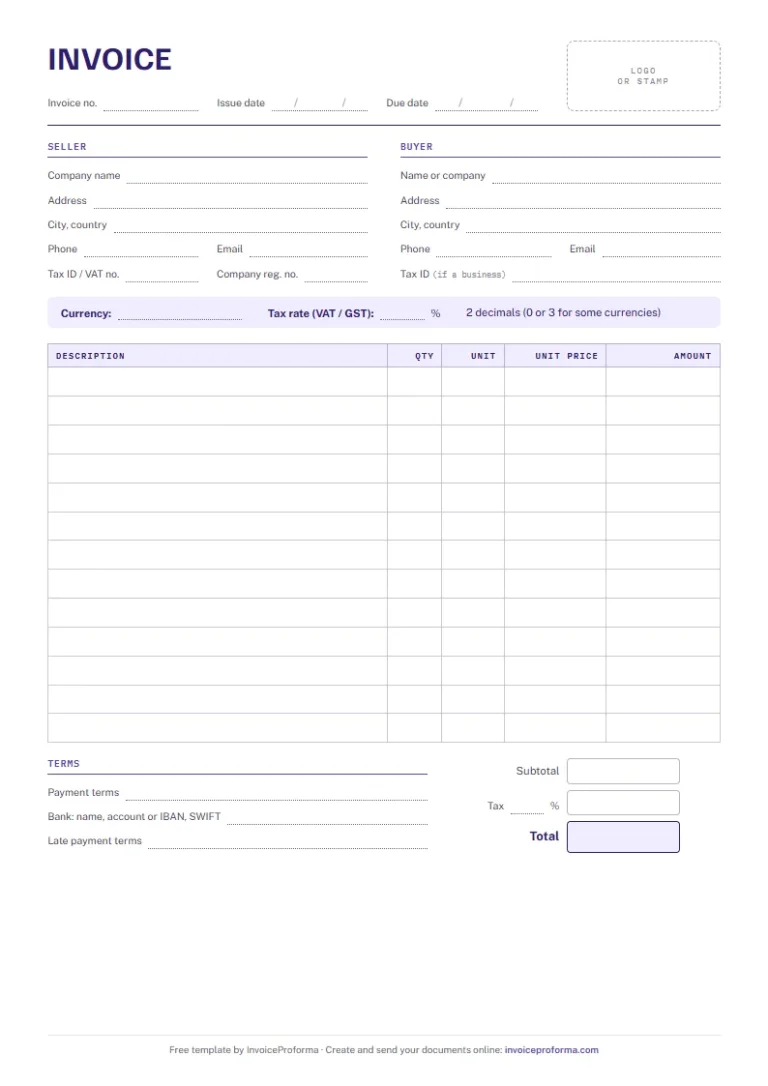
Free invoice template in Word, Excel and PDF: tax IDs, invoice number, due date, lines, tax, total and bank details. For any country and currency. No sign-up.
Six documents, one app
From the quote to the receipt
One customer file, one product list and your own layout serve all six documents. An accepted quote or proforma becomes an invoice without retyping.
1. The price
Quote
QUO-2026-0012
Your price for the job, with a validity date and space for the buyer to accept it.
2. The firm offer
Proforma invoice
PI-2026-042
What your buyer’s bank, their forwarder or their purchasing team asks for before the order.
3. The order
Purchase order
PO-2026-0007
What is ordered, how many and for which delivery date, signed by the buyer.
4. The delivery
Delivery note
DN-2026-0007
It travels with the goods; the consignee signs it and writes down any reservation.
5. The sale
Invoice
INV-2026-0031
The accepted proforma or quote becomes the invoice, with the same lines and currency.
6. The payment
Payment receipt
REC-2026-0019
Proof of a payment, linked to its invoice, with the method and the balance still due.
Your next proforma invoice, already in your colours
Three free documents, no card required. Your tax IDs, bank details and payment terms are typed once, then printed on every PDF.