Free · no sign-up
Commercial invoice template: free in Word, Excel and PDF
The invoice that travels with exported goods: exporter and importer, lines with HS codes and origin, Incoterms® rule, packages and weights, transport document and signed declaration. A4, one page, for customs, banks and couriers.
- Free, no sign-up
- A4, one page
- Updated 18 October 2026
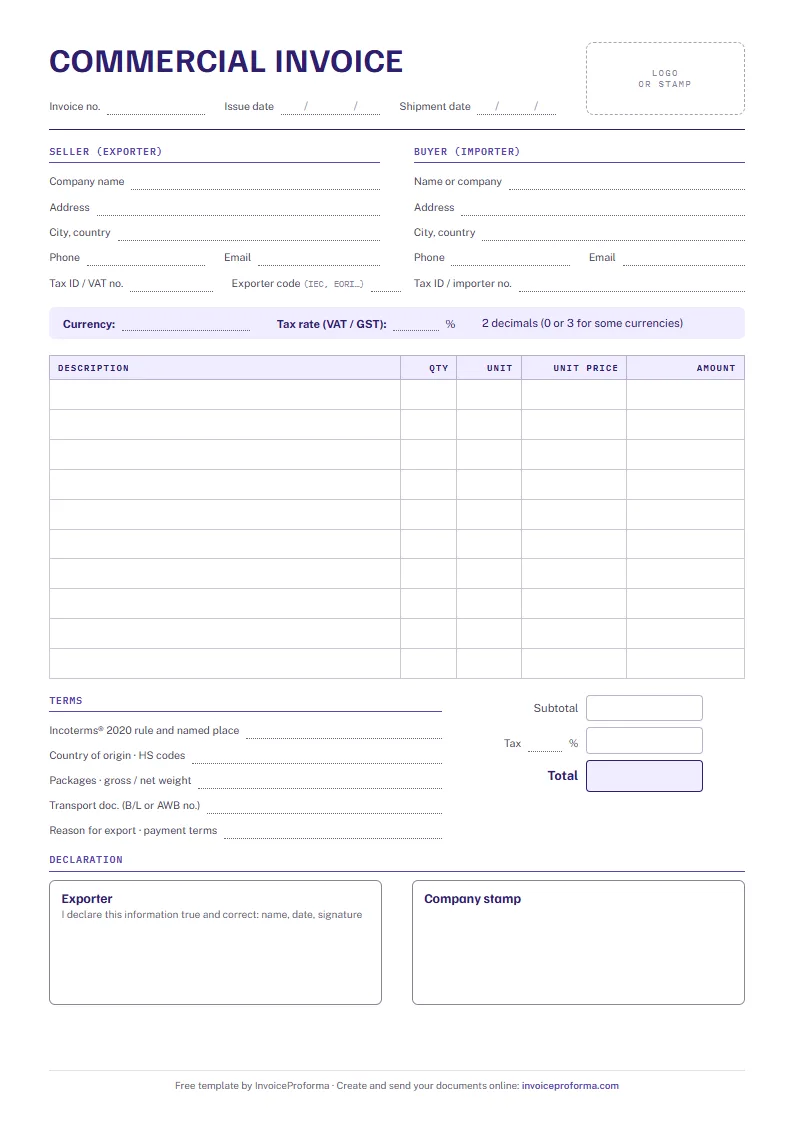
Preview of the commercial invoice template, one A4 page.
What a commercial invoice is
The commercial invoice is the seller’s invoice for goods sold across a border. Customs uses it to check the goods and assess duties and taxes, and the buyer’s bank checks it against a letter of credit. It follows the proforma invoice once the goods ship.
From the template to the app
Turn your accepted proforma into the invoice online, without retyping the lines.
What the template contains
- Header: “Commercial invoice”, the invoice number, the issue date and the shipment date
- Seller (exporter): tax ID or VAT number and exporter code (IEC, EORI…)
- Buyer (importer): tax ID or importer number
- Ten lines with description, quantity, unit, unit price and amount; subtotal, tax and total
- Incoterms® 2020 rule and named place, country of origin and HS codes
- Packages, gross and net weight, transport document number (bill of lading or air waybill)
- Reason for export and payment terms
- Declaration “true and correct” with name, date and signature, and the company stamp
Field by field: what customs and couriers check
| Field | Why it matters |
|---|---|
| Description | What it is, what it is made of, what it is used for. UPS asks for this level of detail; vague words slow clearance. |
| HS code | Customs classifies the goods by it, and UPS strongly recommends one for every line. See HS codes explained. |
| Country of origin | Where the goods were made or assembled, not where they ship from: goods made in Italy and shipped from Germany are of Italian origin. |
| Value and currency | The price actually paid, per unit and per line. Duties are assessed on it. |
| Incoterms® rule | With its named place, for example “CIF Mombasa (Incoterms® 2020)”: it says who pays freight and insurance. See our Incoterms guide. |
| Packages and weights | Must match the packing list and the transport document. |
| Transport document | Bill of lading or air waybill number; with UPS, the tracking number. |
| Declaration and signature | The signed statement that the information is true and correct. |
How many copies
For courier shipments, UPS asks for three signed copies, one original and two copies, when the invoice is not sent electronically; DHL asks for two copies for shipments leaving your country or customs union. The couriers’ paperless services replace the paper copies. For sea and air freight, your forwarder tells you how many originals the bank and the consignee need, especially under a letter of credit.
Commercial invoice, proforma and packing list
The proforma invoice comes first: it is the offer, used for the deposit, the import licence or the letter of credit. The commercial invoice repeats its lines once the goods ship. For goods sent free, such as samples, a proforma takes its place: see proforma invoices for DHL, FedEx and UPS.
The packing list details the packages, their contents and weights. It does not replace the commercial invoice: UPS points out that customs does not use it to assess duties and fees.
Faster online
InvoiceProforma turns your accepted proforma into the invoice in one click, so the lines and prices are copied rather than retyped, in 52 currencies, with your stamp and signature on the PDF. It has no dedicated fields for HS codes, origin or weights: write the HS code and origin in each line’s description, and the Incoterms rule, packages and weights in the document note. It does not produce packing lists. If you need every trade field in its own box, use the free template on this page.
Questions
Commercial Invoice Template: your questions
What is the difference between a commercial invoice and a proforma invoice?
The proforma is an offer sent before the sale or the shipment; the commercial invoice is the invoice for goods actually sold and shipped, used by customs to assess duties.
Who prepares the commercial invoice?
The seller, or exporter. The forwarder or courier uses it, but the seller signs it and is responsible for what it states.
Does a commercial invoice need an HS code?
Customs classifies goods by it, and UPS strongly recommends one per line. Including it avoids queries at clearance.
Is a packing list enough without a commercial invoice?
No. The packing list describes packages and weights; customs relies on the commercial invoice for the value and the duties.
Can I use this template for free samples?
For goods sent free, use a proforma invoice with a value for customs purposes. Our guide for DHL, FedEx and UPS explains what to write.
Sources and updates
Checked on 18 October 2026. Tax and customs rules change: for your own case, confirm with the authority concerned, your bank or a tax adviser.
Read next
Related guides
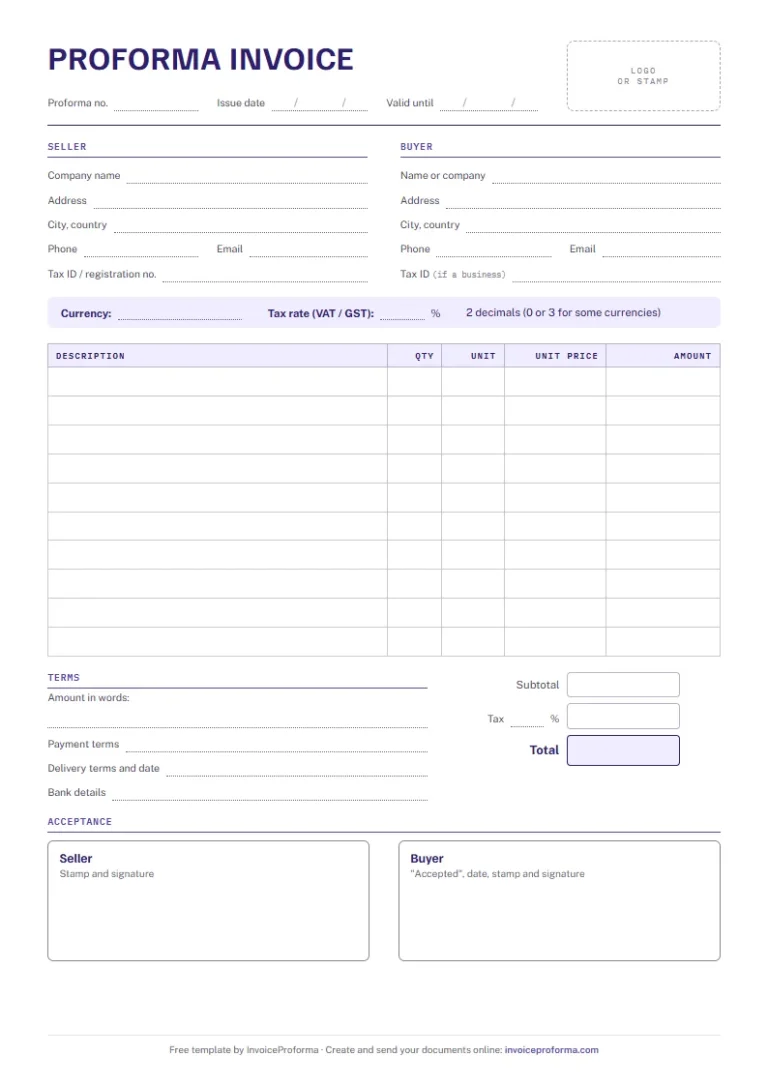
Which document does customs need, and which does the bank? A field-by-field comparison of proforma and commercial invoices, and errors that delay shipments.
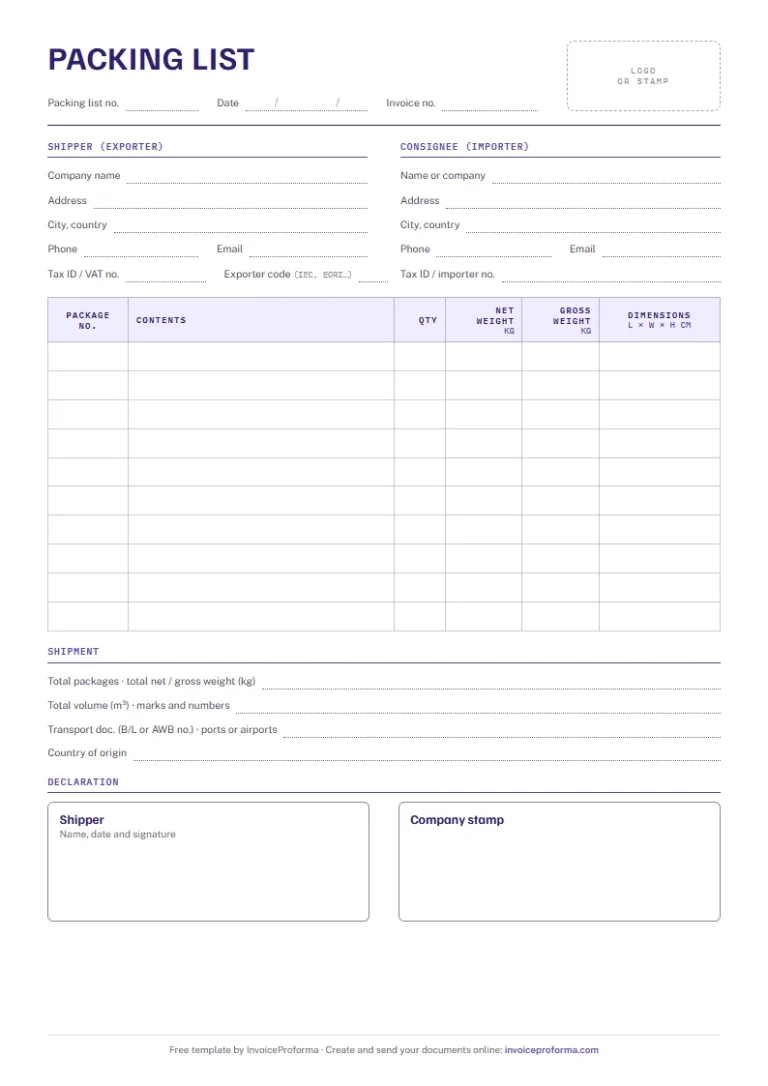
Free export packing list template in Excel, Word and PDF: package numbers, contents, net and gross weights, dimensions, marks and transport document.

When DHL, FedEx and UPS accept a proforma invoice, what it must show (value, reason for export, HS code, origin, signature) and how many copies to send.
Six documents, one app
From the quote to the receipt
One customer file, one product list and your own layout serve all six documents. An accepted quote or proforma becomes an invoice without retyping.
1. The price
Quote
QUO-2026-0012
Your price for the job, with a validity date and space for the buyer to accept it.
2. The firm offer
Proforma invoice
PI-2026-042
What your buyer’s bank, their forwarder or their purchasing team asks for before the order.
3. The order
Purchase order
PO-2026-0007
What is ordered, how many and for which delivery date, signed by the buyer.
4. The delivery
Delivery note
DN-2026-0007
It travels with the goods; the consignee signs it and writes down any reservation.
5. The sale
Invoice
INV-2026-0031
The accepted proforma or quote becomes the invoice, with the same lines and currency.
6. The payment
Payment receipt
REC-2026-0019
Proof of a payment, linked to its invoice, with the method and the balance still due.
Your next proforma invoice, already in your colours
Three free documents, no card required. Your tax IDs, bank details and payment terms are typed once, then printed on every PDF.