Guide · Costs
How to Calculate Landed Cost from a Proforma Invoice
Two suppliers quote the same machine. One says USD 18,400 FOB Ningbo, the other USD 21,900 CIF Le Havre. Which is cheaper? You cannot tell from the quotations. Landed cost — the total amount it takes to place the goods in your warehouse, ready to sell — is the only number that answers the question, and a well-built proforma invoice contains almost everything you need to calculate it.
Updated 17 October 2026 · 4 min read
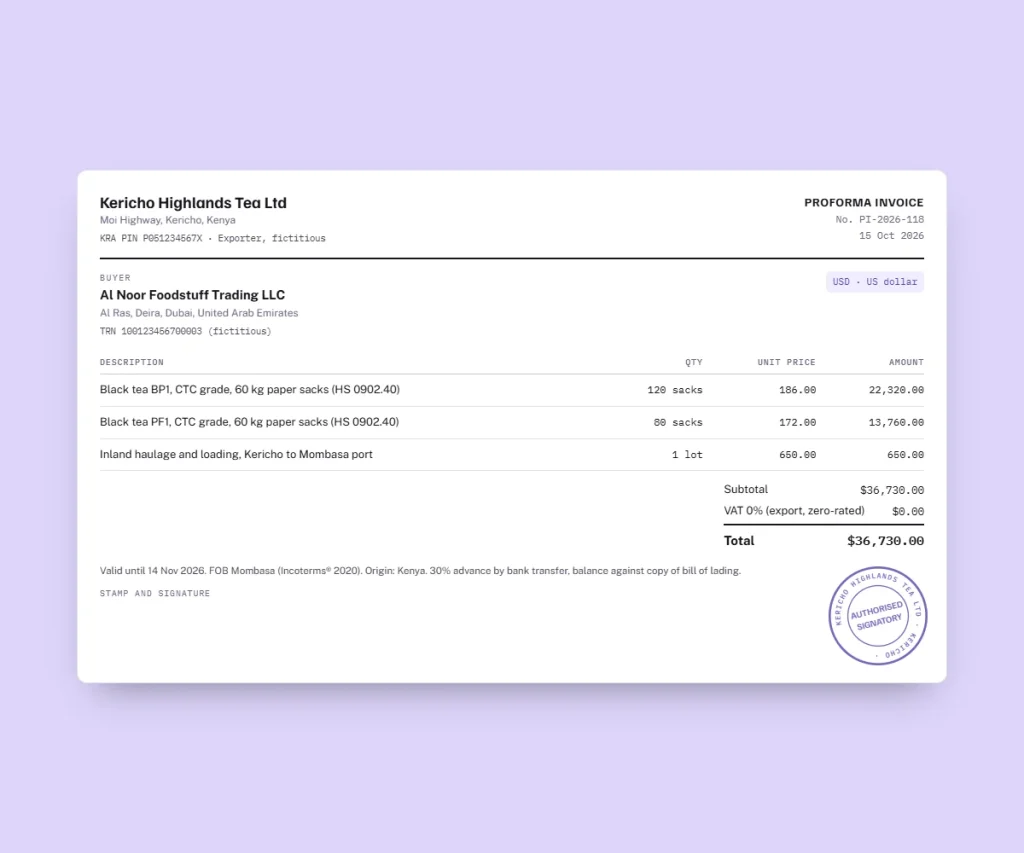
From the guide to the document
Your proforma with these details, ready as a PDF.
The components
- Goods value — the ex-works price of the products themselves.
- Origin charges — inland haulage to the port, export customs formalities, terminal handling at origin, documentation fees.
- Main carriage — ocean or air freight, plus surcharges: bunker adjustment, currency adjustment, congestion, peak season.
- Insurance — usually a small percentage of CIF value, but the deductible matters more than the premium.
- Destination charges — terminal handling, customs clearance fee, port dues, container release, possible inspection.
- Duty — a percentage of the customs value, set by the HS code and the origin.
- Import taxes — VAT, GST or sales tax, plus excise where applicable. Often recoverable, but always a cash-flow cost.
- Final delivery — port to warehouse, unloading, palletising.
- Financing and risk — letter of credit fees, currency conversion spread, the cost of money tied up during a 35-day transit.
- Hidden costs — demurrage and detention, storage, re-labelling, damage, returns.
Start with the Incoterms rule
The rule tells you which of those lines are already inside the supplier’s price. Under FOB, origin charges and export clearance are included but freight, insurance and everything at destination are yours. Under CIF, freight and insurance to the named port are included — but destination terminal handling, clearance, duty and delivery are still yours, and risk transferred to you back at the port of loading. Under DDP, in principle everything is included, which is why DDP quotes look expensive until you build the comparison properly. The Incoterms 2020 guide sets out each rule’s cost allocation.
Then find the duty rate
Duty depends on two things: the HS code and the country of origin. The code gives you the rate in your national tariff; the origin tells you whether a trade agreement lowers it and whether any anti-dumping or safeguard measure raises it. Both must be on the proforma invoice — see the HS code guide. Note also what base the duty is applied to: many countries assess on a CIF value, so freight and insurance are dutiable even when you paid them separately.
A worked comparison
One 40-foot container of finished goods, duty 4.7%, VAT 20% recoverable, delivered to a warehouse in northern France. Amounts in USD.
| Cost line | Supplier A — FOB Ningbo | Supplier B — CIF Le Havre |
|---|---|---|
| Goods | 18,400 | 21,900 (freight and insurance included) |
| Origin charges and export clearance | included in FOB | included |
| Ocean freight | 2,850 | included |
| Marine insurance | 190 | included |
| Customs value (CIF) | 21,440 | 21,900 |
| Duty at 4.7% | 1,008 | 1,029 |
| Destination terminal handling and clearance | 620 | 620 |
| Delivery to warehouse and unloading | 540 | 540 |
| Bank and currency costs | 230 | 150 |
| Landed cost excluding recoverable VAT | 23,838 | 24,239 |
Supplier A is cheaper by roughly 1.7%, not by the 16% the headline prices suggested. And the comparison is still incomplete: if Supplier A’s transit is two weeks longer, the extra stock you must hold has a cost, and if their packaging is weaker, the damage rate does too.
Allocating cost across mixed shipments
Most containers hold several products with different duty rates. Allocate shared costs — freight, terminal handling, clearance — across lines using a consistent driver, then apply duty line by line at the correct rate:
- By value — simple, and appropriate for insurance and finance costs.
- By weight or volume — better for freight, since that is how carriers charge; use whichever of the two is chargeable.
- By unit — only when items are broadly similar in size and value.
Pick one method and keep it. Switching between them between quarters makes your margin analysis meaningless.
What buyers should ask the supplier to put on the proforma
- HS code and country of origin for every line — without them you cannot look up duty.
- The Incoterms 2020 rule with the named place, so you know where their cost stops.
- Freight and insurance as separate lines when the rule includes them, so you can test the customs value and check the deductions your regime allows.
- Gross weight, net weight, package count and volume, so a forwarder can quote without a second email.
- Whether the price includes export packing, pallets and ISPM 15 treatment.
- Validity, so your calculation has a shelf life you can plan around.
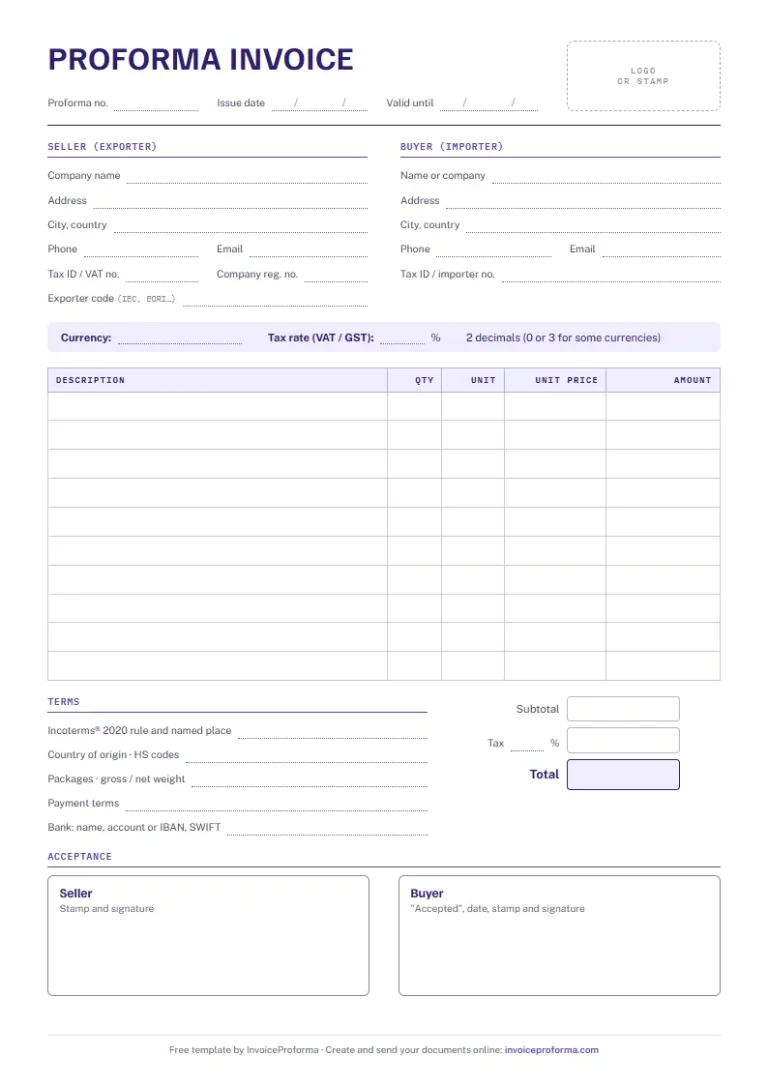
Those are exactly the fields on our proforma invoice template. If your supplier’s document is missing them, send them the template — it saves both sides a week.
The costs people forget
- Demurrage and detention. Free time at destination is short. Paperwork that arrives late turns into a daily charge per container.
- Customs examination. If your consignment is selected, you pay for the move, the unpack and the repack.
- Currency. The spread on converting to the supplier’s currency is a real cost; so is the movement between quotation and payment.
- Compliance. Certification, testing, labelling and translation for the destination market.
- Working capital. Cash paid at deposit and released only when the goods are sold, sometimes 90 days later.
Turning landed cost into a selling price
Divide the landed cost by the number of saleable units — not by the units shipped, if breakage is normal for your product. Then add your operating cost and target margin. Rerun the calculation whenever freight rates move sharply or a trade measure changes, because both can shift a product from profitable to marginal without anything happening on the supplier side.
Related reading: what a proforma invoice is, the export documents checklist, and country import requirements. To issue the proforma itself, create a free account: write the HS code and origin in each line, and the Incoterms rule in the note.
Read next
Related guides
EXW to DDP explained with a worked cost table: who pays freight, insurance and duty, where risk passes, and what changed from Incoterms 2010.
How Harmonized System codes are built, what the six digits mean, the rules that settle classification disputes, and a practical method for finding your code.
What the EU, US, Gulf, Nigeria, Kenya, North Africa and India expect before shipment: licences, exchange control and pre-shipment inspection.
Six documents, one app
From the quote to the receipt
One customer file, one product list and your own layout serve all six documents. An accepted quote or proforma becomes an invoice without retyping.
1. The price
Quote
QUO-2026-0012
Your price for the job, with a validity date and space for the buyer to accept it.
2. The firm offer
Proforma invoice
PI-2026-042
What your buyer’s bank, their forwarder or their purchasing team asks for before the order.
3. The order
Purchase order
PO-2026-0007
What is ordered, how many and for which delivery date, signed by the buyer.
4. The delivery
Delivery note
DN-2026-0007
It travels with the goods; the consignee signs it and writes down any reservation.
5. The sale
Invoice
INV-2026-0031
The accepted proforma or quote becomes the invoice, with the same lines and currency.
6. The payment
Payment receipt
REC-2026-0019
Proof of a payment, linked to its invoice, with the method and the balance still due.
3 free documents to try it, no card required.
Your next proforma invoice, already in your colours
Three free documents, no card required. Your tax IDs, bank details and payment terms are typed once, then printed on every PDF.