Guide · Basics
What Is a Proforma Invoice? Meaning, Format and Uses
A proforma invoice is a written offer to sell, presented in the layout of an invoice. It tells a foreign buyer exactly what they will receive, at what price, on which delivery terms and by which payment method — before anything is manufactured, packed or shipped. It is not a demand for payment, it does not enter your sales ledger, and no tax authority expects to see it in a VAT return. In international trade, however, it is often the single most requested document of the entire transaction.
Updated 17 October 2026 · 5 min read
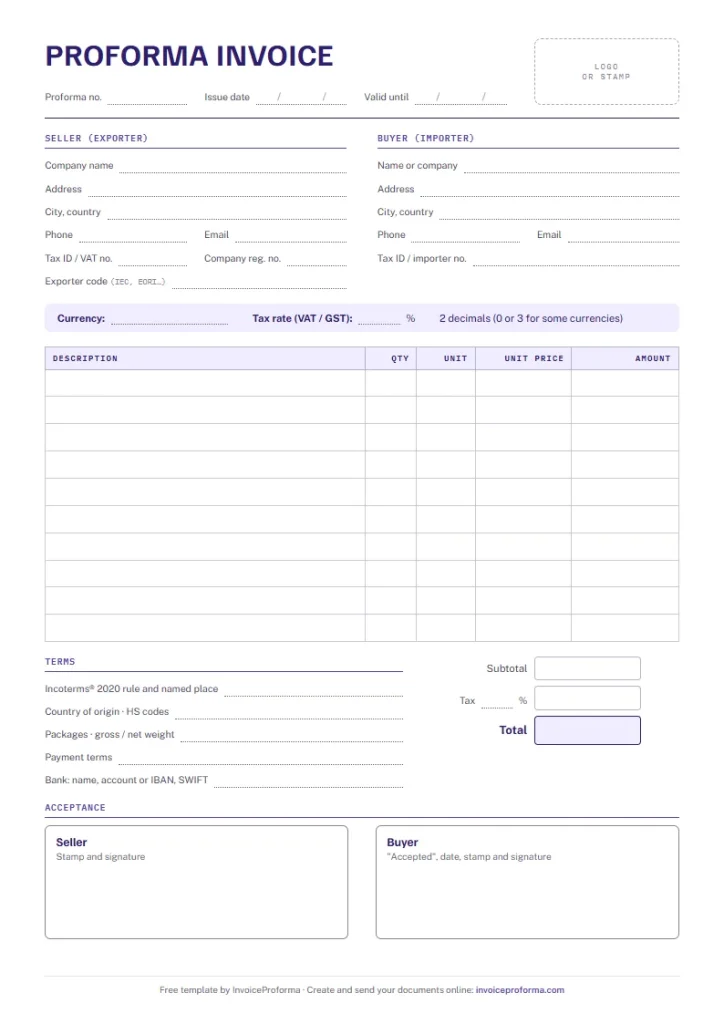
From the guide to the document
Your proforma with these details, ready as a PDF.
The reason is simple. Before a container leaves, several parties who are not your customer need to know the exact contents and value of the shipment: a bank that will issue a letter of credit, a ministry that will grant an import licence, an insurer pricing the cargo cover, a freight forwarder booking space. None of them can wait for the commercial invoice, because the commercial invoice cannot exist until the goods do. The proforma fills that gap.
What the document actually is
“Pro forma” is Latin for “as a matter of form”. The document borrows the form of an invoice — header, line items, totals — but carries none of its accounting consequences. Three properties follow from that:
- It creates no receivable. Issuing one does not mean money is owed to you. It should never be numbered in the same sequence as your commercial invoices, or your accountant will spend the year-end reconciling phantom sales.
- It is time-limited. Because it is an offer, it expires. A validity period of 15, 30 or 60 days protects you against currency movements, freight rate spikes and raw-material price changes between quotation and order.
- It becomes binding on acceptance. When a buyer signs and stamps it, or instructs their bank to open a credit that quotes its number, the terms written on it are the terms of the contract. Vague wording here is expensive later.
When a foreign buyer asks for one
To open a letter of credit
A bank asked to guarantee payment needs to describe the goods in the credit itself. The applicant — your buyer — copies that description from your proforma. If your document says “cotton fabric” and the credit ends up saying “100% combed cotton poplin, 120 gsm”, your shipping documents must match the credit, not your original wording. Precision at proforma stage prevents discrepancies at presentation stage. See our guide to letters of credit for small exporters.
To obtain an import licence or foreign exchange
Many countries operating exchange controls require the importer to register the transaction before funds may leave the country. The registration file is built around a supplier’s proforma invoice: Nigeria’s Form M, Algeria’s bank domiciliation, and various central-bank approvals in South Asia and Sub-Saharan Africa all work this way. In these markets an incomplete proforma does not slow a deal down by a day — it stops it entirely until a corrected version is issued.
To budget landed cost
A professional importer does not compare unit prices; they compare landed cost. To calculate it they need your HS codes (to look up duty rates), the Incoterms rule (to know which costs you have already included), gross weight and volume (to price freight) and country of origin (to test whether a trade agreement gives them preferential duty). A proforma that carries all four turns a week of email into one decision.
For customs formalities that are not a definitive import
Samples with no commercial value, goods sent for repair and return, exhibition material under temporary admission, and warranty replacements are all movements where no sale takes place. There is no commercial invoice to present, so customs authorities accept a proforma stating a value “for customs purposes only”. Details in proforma invoices for customs clearance.
What must appear on an export proforma invoice
A domestic quotation can be a paragraph in an email. An export proforma cannot. The table below separates what is genuinely mandatory from what merely looks professional.
| Field | Why it is there | Status |
|---|---|---|
| Title “Proforma Invoice” | Prevents the buyer’s accounts department from paying it twice, once against the proforma and once against the invoice | Mandatory |
| Reference number and date | Quoted in the letter of credit, the licence application and later the commercial invoice | Mandatory |
| Validity date | Ends your price exposure; licence authorities often reject undated offers | Mandatory |
| Seller, buyer, consignee, notify party | The three addresses are frequently different in trade; the transport document needs all of them | Mandatory |
| Description of goods | Copied verbatim into the credit and the customs declaration | Mandatory |
| HS code per line | Determines duty, VAT, licences and prohibitions at destination | Strongly recommended |
| Country of origin | Decides preferential duty and anti-dumping exposure | Mandatory in most import files |
| Quantity, unit, unit price, line total | Basis of the customs value and of the bank’s payment | Mandatory |
| Currency | An amount without a currency is unusable for a credit application | Mandatory |
| Incoterms 2020 rule + named place | Allocates transport cost, insurance and risk between the parties | Mandatory |
| Port of loading / port of discharge | Needed for the booking and for the credit’s shipment fields | Strongly recommended |
| Gross and net weight, packages, volume | Freight quotation, manifest and declaration | Strongly recommended |
| Payment terms | Advance, deposit percentage, documentary collection, letter of credit at sight or usance | Mandatory |
| Bank details | The buyer’s bank cannot remit without the full account, SWIFT/BIC and IBAN where applicable | Mandatory for transfers |
| Lead time and partial shipment / transhipment position | These clauses are written into the credit; contradicting them later causes discrepancies | Recommended |
| Signature and company stamp | Several import regimes reject unsigned documents outright | Recommended |
Proforma, quotation and commercial invoice
The three documents are often confused because they can carry identical figures. They are used at different moments and by different people.
- Quotation. Commercial, informal, negotiable. Read by the buyer’s purchasing manager. Rarely accepted by a bank.
- Proforma invoice. A firm offer in invoice layout, complete enough to be lodged with a bank or a licensing authority. Read by the buyer, the bank and the regulator.
- Commercial invoice. Issued when the goods actually ship. It is the accounting and customs valuation document, and it is what triggers payment. Read by customs, the carrier and both accounting departments.
The practical rule: whatever the proforma says, the commercial invoice must repeat — same buyer, same description, same HS codes, same Incoterms rule, same currency. A full side-by-side comparison is in proforma invoice vs commercial invoice.
Five mistakes that cost exporters money
- Writing “CIF” without a named port. CIF Shanghai and CIF Ningbo are different prices. The Incoterms rule is only complete with a place and the year of the rules.
- Omitting the HS code. The importer guesses, the guess is wrong, the goods are reclassified at destination and the extra duty becomes an argument about who pays.
- No validity date. A buyer returns four months later expecting the same price after freight has doubled.
- A description too short for the credit. “Machine parts” is not a description a bank can work with, and it is an invitation for customs to reclassify the goods at a higher rate.
- Numbering proformas in the commercial invoice sequence. It corrupts the audit trail and confuses the buyer’s payables team.
How long should a proforma stay valid?
Match the validity to your real exposure. If the price depends on a commodity input, 15 days may be generous. If you are quoting a machine built to order with a six-month lead time, 60 to 90 days is normal — but state clearly that the price is firm and the delivery time runs from receipt of the deposit or from the date the letter of credit is advised. Buyers in licence-controlled markets often need 60 days simply to complete their paperwork, so a 15-day validity can disqualify you from those tenders.
Next steps
Get the classification right before you quote: our HS code guide explains how the six-digit structure works and how to find yours. Then choose the delivery rule with the Incoterms 2020 guide, and check what you will have to produce at shipment with the export documents checklist.
When you are ready to issue one, use a free template or create your document online — your first three documents are free.
Read next
Related guides
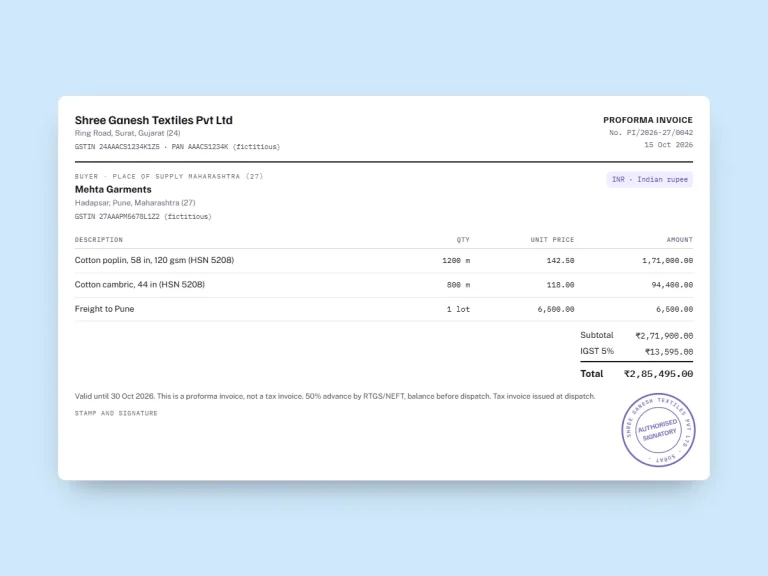
A proforma invoice is an offer; an invoice is a demand for payment. Legal effect, tax, accounting and numbering compared, with a table and examples.
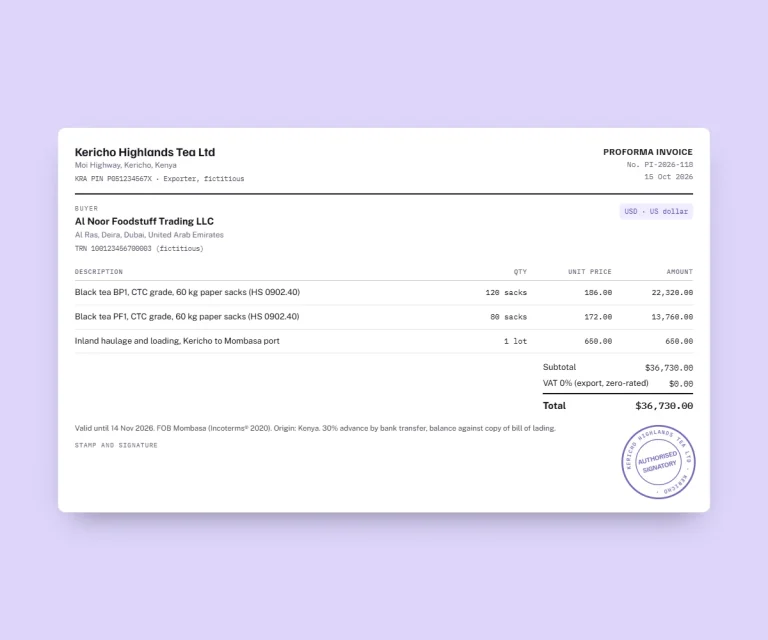
Three filled proforma invoice examples: an export from Kenya in US dollars, a GST proforma in India and a VAT proforma in Nigeria, every line explained.
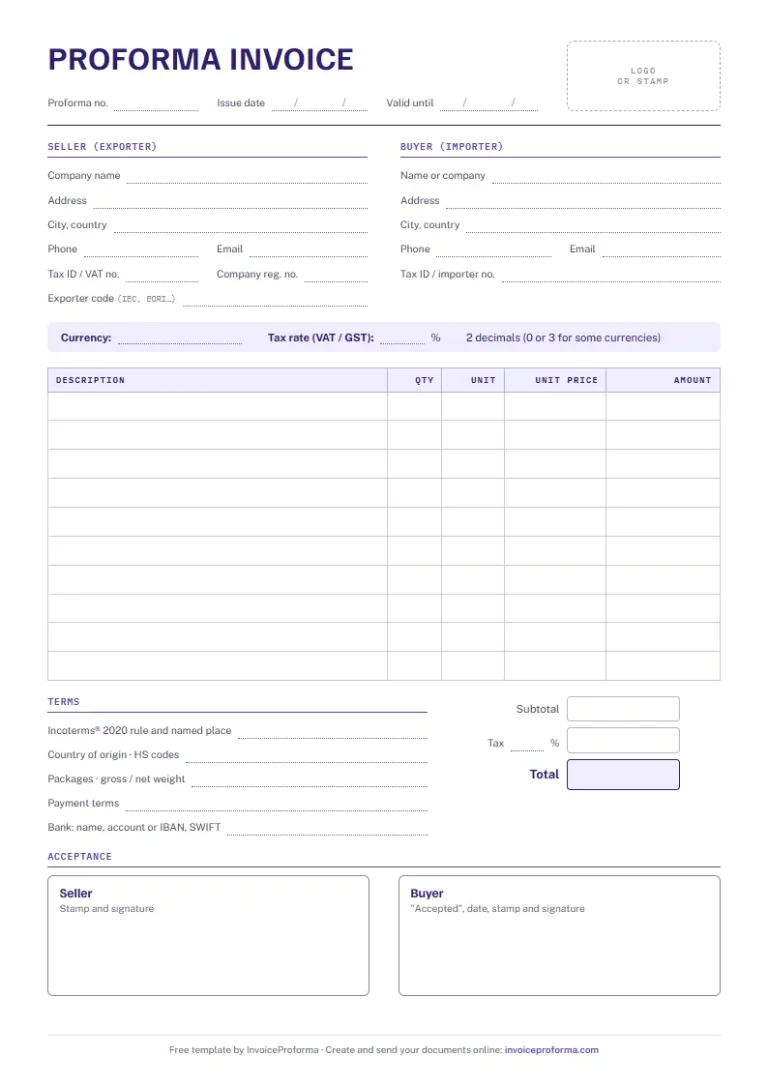
An export version with Incoterms, origin and HS codes, and a simple version. No sign-up.
Six documents, one app
From the quote to the receipt
One customer file, one product list and your own layout serve all six documents. An accepted quote or proforma becomes an invoice without retyping.
1. The price
Quote
QUO-2026-0012
Your price for the job, with a validity date and space for the buyer to accept it.
2. The firm offer
Proforma invoice
PI-2026-042
What your buyer’s bank, their forwarder or their purchasing team asks for before the order.
3. The order
Purchase order
PO-2026-0007
What is ordered, how many and for which delivery date, signed by the buyer.
4. The delivery
Delivery note
DN-2026-0007
It travels with the goods; the consignee signs it and writes down any reservation.
5. The sale
Invoice
INV-2026-0031
The accepted proforma or quote becomes the invoice, with the same lines and currency.
6. The payment
Payment receipt
REC-2026-0019
Proof of a payment, linked to its invoice, with the method and the balance still due.
3 free documents to try it, no card required.
Your next proforma invoice, already in your colours
Three free documents, no card required. Your tax IDs, bank details and payment terms are typed once, then printed on every PDF.