Guide · Payment
Letters of Credit for Small Exporters
A documentary credit — commonly called a letter of credit or L/C — replaces your buyer’s promise to pay with a bank’s promise to pay. The bank pays when you present documents that comply with the credit. Not when the goods arrive, not when the buyer is satisfied: when the paperwork is right. For a small exporter shipping to an unfamiliar market, that shift is the difference between a manageable risk and a gamble.
Updated 17 October 2026 · 5 min read
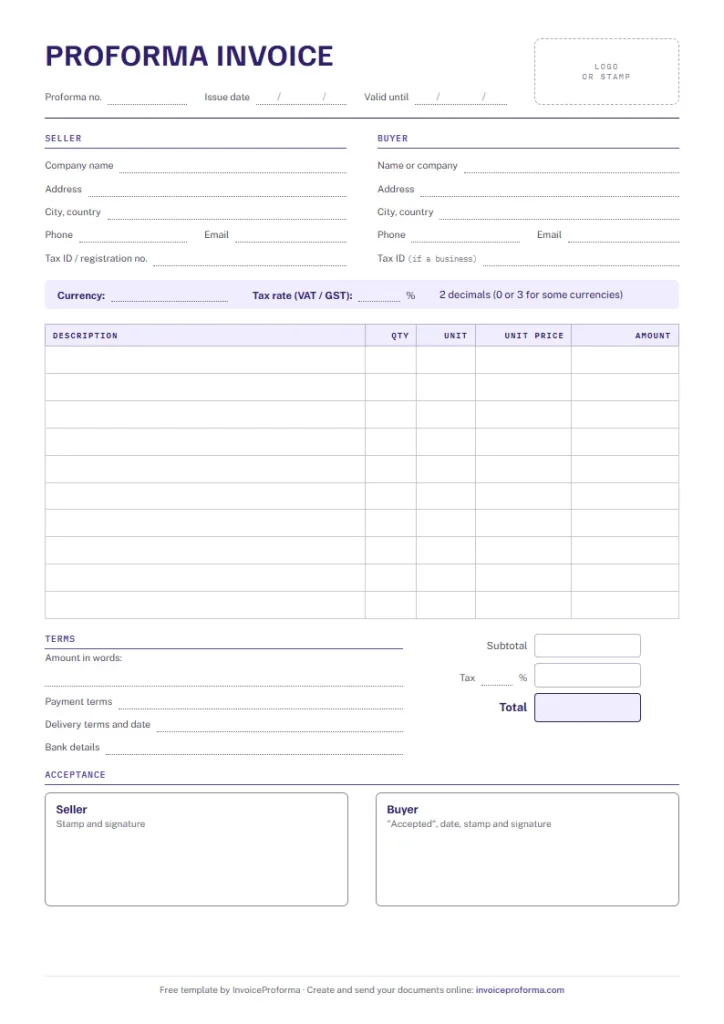
From the guide to the document
Your proforma with these details, ready as a PDF.
Who is who
| Party | Role |
|---|---|
| Applicant | The buyer, who asks their bank to issue the credit — usually on the basis of your proforma invoice |
| Issuing bank | The buyer’s bank; it takes on the obligation to pay against compliant documents |
| Advising bank | A bank in your country that authenticates the credit and passes it to you |
| Confirming bank | A bank that adds its own undertaking, so you are no longer relying on a bank in the buyer’s country |
| Beneficiary | You, the exporter |
| Nominated bank | The bank authorised to receive and examine your documents and to pay, accept or negotiate |
Nearly all credits are issued subject to UCP 600, the ICC’s Uniform Customs and Practice for Documentary Credits. ISBP 745 is the companion publication that describes how banks actually examine documents in practice — worth its cost if you ship under credits regularly.
The sequence, step by step
- You issue a proforma invoice. It states the goods, the amount, the currency, the Incoterms 2020 rule with named place, the shipment period and the required documents.
- The buyer applies to their bank. The application copies your proforma. Everything wrong in your document is now wrong in the credit.
- The credit is issued and advised to you through a bank in your country.
- You check the credit — before producing anything. This step is skipped constantly and it is the most important one on this page.
- You ship within the latest shipment date and collect the transport document.
- You present the documents to the nominated bank within the presentation period and before the credit expires.
- The bank examines them. Under UCP 600 it has a maximum of five banking days following presentation to decide.
- Payment follows — at sight, or at maturity if the credit is a usance credit.
Checking the credit when it arrives
Read it as a list of things you must be able to do. If any line is outside your control, ask for an amendment immediately — amendments are cheap before production and painful afterwards.
- Is it irrevocable? Under UCP 600 every credit is irrevocable unless it says otherwise, but confirm it.
- Do you need confirmation? If the issuing bank or its country carries risk you are not comfortable with, ask for a confirmed credit and agree who pays the confirmation fee.
- Is the amount and currency right, and does any tolerance (“about”, or plus/minus a percentage) match how you actually ship?
- Are the dates workable? Latest shipment date, expiry date, and the presentation period — if none is stated, 21 calendar days after the shipment date applies, and never later than expiry.
- Where does the credit expire? A credit expiring at the counters of the issuing bank abroad means your documents must physically arrive there in time. Ask for expiry in your own country.
- Does the goods description match your proforma? Character for character, including model numbers.
- Are partial shipments and transhipment allowed? Container traffic is almost always transhipped somewhere.
- Can you produce every required document? Certificates issued by the buyer, or inspection certificates signed by a named individual, put payment back in the applicant’s hands and defeat the purpose of the credit.
- Are the Incoterms in the credit the ones you quoted? A credit calling for freight-prepaid documents under an FOB price is a contradiction you must resolve before shipping.
The usual document set
| Document | What banks look for |
|---|---|
| Commercial invoice | Issued by the beneficiary, addressed to the applicant, same currency as the credit, goods description corresponding to the credit, amount not exceeding the credit |
| Transport document (B/L, air waybill, CMR, forwarder’s receipt) | Correct type, consignee and notify exactly as instructed, on-board notation where a marine bill of lading is required, freight prepaid or collect per the terms, full set of originals when called for |
| Packing list | Package count, marks and numbers, gross and net weights consistent with the transport document |
| Insurance document | Required under CIF and CIP, in the credit currency, cover at least 110% of the invoice value unless stated otherwise, effective no later than the shipment date |
| Certificate of origin | Issuer as specified — often a chamber of commerce; consistent with the invoice and, where required, legalised |
| Inspection or pre-shipment certificate | Issued by the named body; check who appoints and pays for the inspection |
| Bill of exchange (draft) | Drawn on the party the credit names, for the right tenor |
Details on each of these are in the export documents checklist.
Why presentations get refused
A large share of first presentations contain at least one discrepancy. The recurring ones are mundane:
- Documents presented after the presentation period or after expiry
- Late shipment — the on-board date falls after the latest shipment date
- Goods description on the invoice differing from the credit
- Inconsistent data between documents: weights that disagree, a consignee spelled differently, a vessel name missing
- Insurance cover below 110%, in the wrong currency, or dated after shipment
- An incomplete set of original bills of lading
- Missing signature, missing endorsement, or a document not issued by the party the credit names
- Amount drawn exceeding the credit, or a quantity outside the permitted tolerance
If the bank finds a discrepancy it must notify you once, stating every discrepancy, within the five-banking-day window. You can then correct and re-present if there is time, ask the applicant to waive the discrepancy, or fall back to a documentary collection. None of those is as good as presenting clean documents the first time.
Cost, and when a credit is worth it
Expect issuance and advising fees, a confirmation fee if you ask for one, document examination fees, amendment fees and courier charges. Together they typically run to a low single-digit percentage of the shipment value, higher for small shipments and for issuing banks in higher-risk jurisdictions. Under a usance credit you may be able to discount the accepted draft and receive funds early, at a cost.
Use a credit when the amount is large relative to your cash flow, the buyer is new, the country carries transfer risk, or local rules require it. For small repeat orders with a trusted buyer, the fees and the administrative load rarely justify it.
The alternatives
| Method | Security for the exporter | Typical use |
|---|---|---|
| Advance payment | Highest | Samples, small orders, new buyers |
| Deposit plus balance before shipment | High | Made-to-order goods; 30/70 is a common split |
| Confirmed irrevocable credit | High | Large shipments, higher-risk markets |
| Unconfirmed credit | Medium — you carry issuing-bank and country risk | Established corridors, sound banks |
| Documents against payment (D/P) | Medium — you keep control of the goods, but the buyer can walk away | Repeat buyers, shorter routes |
| Documents against acceptance (D/A) | Low | Long relationships, or with credit insurance |
| Open account | Lowest | Trusted long-term buyers; consider credit insurance |
Wording your proforma invoice for a credit
Because the credit is written from your proforma, state on it: the payment method in full (“Irrevocable letter of credit at sight, confirmed by a first-class bank in the seller’s country, available with any bank by negotiation”), the documents you will present, the shipment period counted from the date the credit is advised, the ports of loading and discharge, whether partial shipment and transhipment must be allowed, the tolerance you need, and who bears which bank charges. Ten lines on the proforma prevent an amendment cycle later.
Related reading: what a proforma invoice must contain, Incoterms 2020, and proforma vs commercial invoice. When the wording is ready, create the proforma invoice online: the description you write is exactly what prints on the PDF.
General information for exporters, not banking or legal advice. Your credit is governed by its own terms, by UCP 600 where it is incorporated, and by applicable law. Ask your bank’s trade finance desk to review any credit before you produce goods against it.
Read next
Related guides
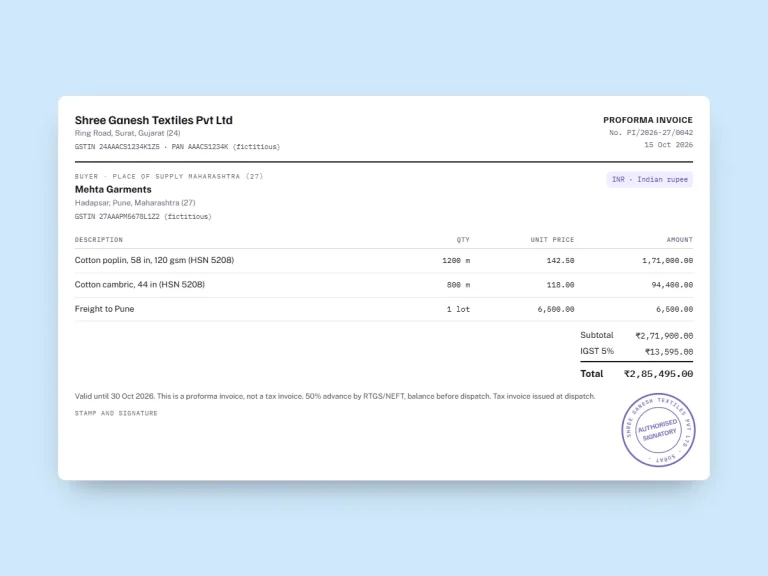
How to request an advance payment with a proforma invoice: what to write, sample wording, what to issue when the money arrives, and tax on advances.
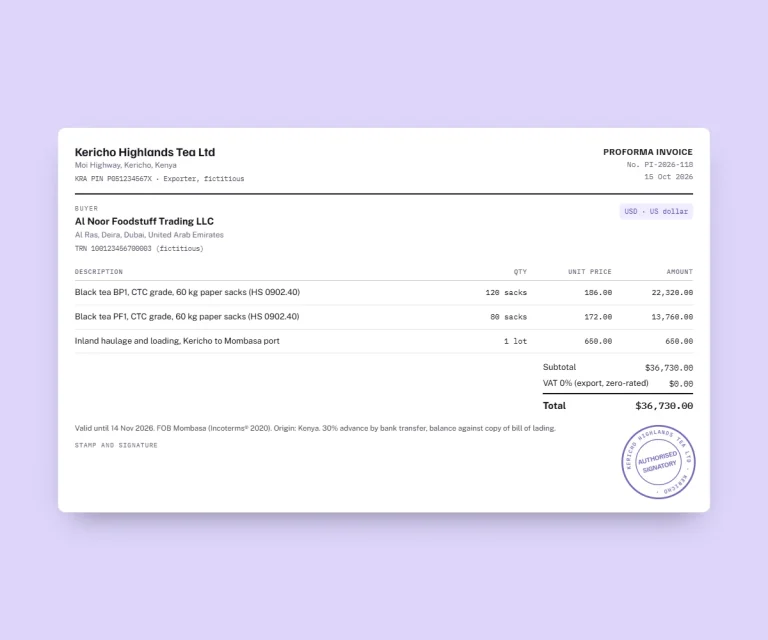
EXW to DDP explained with a worked cost table: who pays freight, insurance and duty, where risk passes, and what changed from Incoterms 2010.
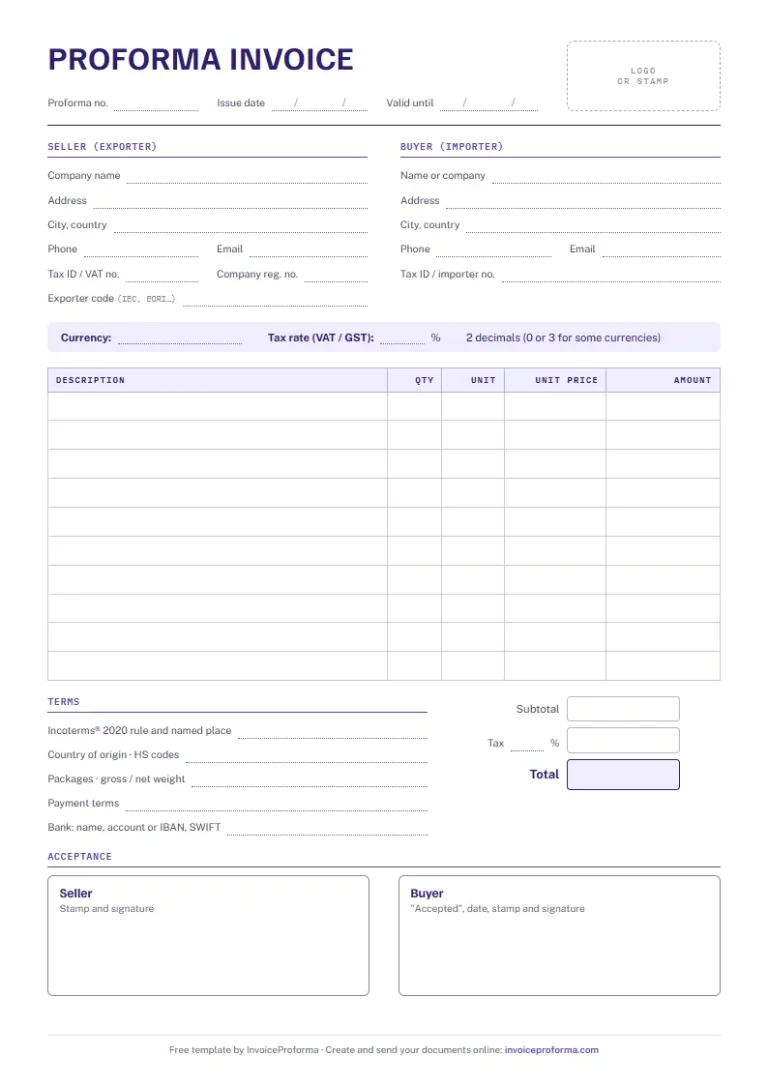
Proforma invoice meaning: an offer to sell in invoice form. What it must contain for customs, banks and import licences, how long it stays valid.
Six documents, one app
From the quote to the receipt
One customer file, one product list and your own layout serve all six documents. An accepted quote or proforma becomes an invoice without retyping.
1. The price
Quote
QUO-2026-0012
Your price for the job, with a validity date and space for the buyer to accept it.
2. The firm offer
Proforma invoice
PI-2026-042
What your buyer’s bank, their forwarder or their purchasing team asks for before the order.
3. The order
Purchase order
PO-2026-0007
What is ordered, how many and for which delivery date, signed by the buyer.
4. The delivery
Delivery note
DN-2026-0007
It travels with the goods; the consignee signs it and writes down any reservation.
5. The sale
Invoice
INV-2026-0031
The accepted proforma or quote becomes the invoice, with the same lines and currency.
6. The payment
Payment receipt
REC-2026-0019
Proof of a payment, linked to its invoice, with the method and the balance still due.
3 free documents to try it, no card required.
Your next proforma invoice, already in your colours
Three free documents, no card required. Your tax IDs, bank details and payment terms are typed once, then printed on every PDF.