Guide · Trade terms
Incoterms 2020 Guide
Incoterms rules answer three questions and only three: who arranges and pays for carriage, where risk passes from seller to buyer, and who handles export and import formalities. They are published by the International Chamber of Commerce; the current edition, Incoterms 2020, took effect on 1 January 2020. They do not transfer ownership, set a payment method or replace your sale contract.
Updated 17 October 2026 · 5 min read
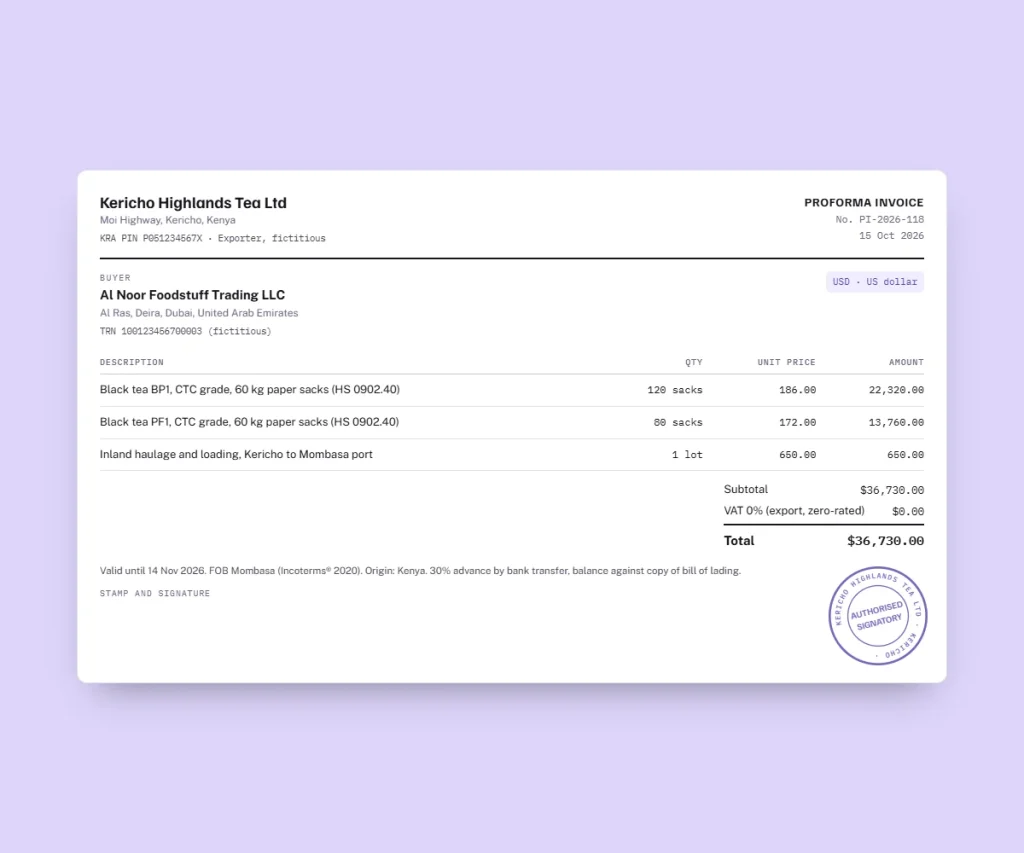
From the guide to the document
Your proforma with these details, ready as a PDF.
How to write the rule correctly
A complete term has three parts: the three-letter rule, the named place, and the edition. “CIP Nairobi, Incoterms 2020” is complete. “CIP” is not. For the four sea rules the named place is a port; for the seven multimodal rules it is a place — a factory gate, a terminal, a warehouse, an address. The more precise the point, the fewer arguments about who pays for the last kilometre.
The 11 rules at a glance
Seven rules for any mode of transport
| Rule | Risk passes | Main carriage paid by | Insurance | Export / import clearance |
|---|---|---|---|---|
| EXW Ex Works | At the seller’s premises, goods placed at buyer’s disposal, not loaded | Buyer | Neither party obliged | Buyer does both — including export, which is often impractical |
| FCA Free Carrier | On delivery to the carrier named by the buyer (loaded, if at seller’s premises) | Buyer | Neither party obliged | Seller exports, buyer imports |
| CPT Carriage Paid To | On handover to the first carrier — early, at origin | Seller | Neither party obliged | Seller exports, buyer imports |
| CIP Carriage and Insurance Paid To | On handover to the first carrier | Seller | Seller must insure — all-risks level (Institute Cargo Clauses A or similar) | Seller exports, buyer imports |
| DAP Delivered at Place | At the named destination, on the arriving vehicle, ready for unloading | Seller | Neither party obliged | Seller exports; buyer imports and pays duty |
| DPU Delivered at Place Unloaded | At the named destination, once unloaded | Seller | Neither party obliged | Seller exports; buyer imports and pays duty |
| DDP Delivered Duty Paid | At the named destination, ready for unloading | Seller | Neither party obliged | Seller does everything, including import duty and taxes |
Four rules for sea and inland waterway transport only
| Rule | Risk passes | Main carriage paid by | Insurance | Export / import clearance |
|---|---|---|---|---|
| FAS Free Alongside Ship | When goods are placed alongside the vessel at the named port | Buyer | Neither party obliged | Seller exports, buyer imports |
| FOB Free on Board | When goods are on board the vessel | Buyer | Neither party obliged | Seller exports, buyer imports |
| CFR Cost and Freight | When goods are on board at the port of loading | Seller (to the destination port) | Neither party obliged | Seller exports, buyer imports |
| CIF Cost, Insurance and Freight | When goods are on board at the port of loading | Seller (to the destination port) | Seller must insure — minimum cover only (Institute Cargo Clauses C or similar) | Seller exports, buyer imports |
The trap in CFR, CIF, CPT and CIP
In all four, the seller pays freight to a destination but risk transfers at origin. A buyer reading “CIF Durban” naturally assumes the seller carries the risk to Durban. They do not. If the container is lost mid-ocean, the goods were at the buyer’s risk from the moment they crossed the ship’s rail — the seller has still performed and is still entitled to payment. The insurance policy, not the Incoterms rule, is what protects the buyer. Explain this before the contract, not after a claim.
What changed from Incoterms 2010
- DAT became DPU. Delivery is no longer restricted to a terminal — it can be any place, provided the seller unloads. DPU remains the only rule under which the seller must unload.
- CIP now requires a higher level of insurance — all-risks cover — while CIF keeps the minimum-cover default. Parties may still agree otherwise in the contract.
- FCA gained an on-board bill of lading option. The parties can agree that the buyer instructs the carrier to issue an on-board bill of lading to the seller after loading, which lets exporters use FCA under letters of credit that demand a marine bill of lading. Historically this problem pushed sellers into FOB even when the goods travelled in containers.
- Cost allocation was consolidated into article A9/B9 of each rule, so each party can see their costs in one place.
- Own means of transport was recognised in FCA, DAP, DPU and DDP — carriage does not have to be contracted with a third party.
- Security-related obligations were made explicit throughout, reflecting screening and advance-declaration requirements.
Choosing a rule in practice
If you are exporting for the first time
FCA at your premises or at a named terminal is usually the cleanest choice. You handle export clearance — which only you can do, since the export declaration is filed in your name — and the buyer’s forwarder takes over from there. Avoid EXW: it obliges the buyer to complete an export declaration in a country where they may have no legal presence, and it leaves you without proof of export for your own tax purposes.
If the buyer is opening a letter of credit
CFR or CIF are still the most common for full container loads, because the credit usually calls for a marine bill of lading and freight prepaid. If you prefer FCA, use the on-board bill of lading option and make sure the credit is written to accept it. See letters of credit for small exporters.
If the buyer wants a single delivered price
DAP puts the goods at their door with import duty still on their side. DDP goes further and makes you responsible for import clearance and duty — which requires you to be able to register for tax and act as importer of record in the destination country. In many markets a foreign company simply cannot do that. Quote DDP only when you have verified you can.
Who pays what: a worked example
One 20-foot container of machine parts, factory in Izmir to a warehouse in Casablanca. Costs: inland haulage to Izmir port 300, export customs 120, ocean freight 900, marine insurance 150, import duty and VAT 2,400, destination terminal handling 250, delivery to the warehouse 350.
| Rule | Seller’s cost | Buyer’s cost | Risk transfers |
|---|---|---|---|
| EXW Izmir factory | 0 | 4,470 | At the factory |
| FOB Izmir | 420 | 4,050 | On board at Izmir |
| CFR Casablanca | 1,320 | 3,150 | On board at Izmir |
| CIF Casablanca | 1,470 | 3,000 | On board at Izmir |
| DAP Casablanca warehouse | 2,070 | 2,400 | At the warehouse, before unloading |
| DDP Casablanca warehouse | 4,470 | 0 | At the warehouse, before unloading |
Two lessons. First, the headline unit price means nothing without the rule — a CIF price that looks 12% higher than FOB may be cheaper once the buyer’s own freight is added. Second, only the D-rules move the risk downstream; CFR and CIF do not.
Incoterms and your documents
The rule you choose changes the customs value at destination, because freight and insurance are included or excluded accordingly. It also determines which transport document you will hold, and whether an insurance certificate belongs in your document set. Write the rule identically on the proforma invoice, the commercial invoice, the sale contract and the letter of credit. A mismatch between “CIF Casablanca” on the invoice and “CFR Casablanca” in the credit is a discrepancy, and the bank is entitled to refuse the documents.
Next: check what else the shipment needs in the export documents checklist, review classification in the HS code guide, compare supplier quotes properly with the landed cost method, or issue a proforma invoice online with the Incoterms rule and named place in its note.
Incoterms is a trademark of the International Chamber of Commerce. This guide is an independent summary for exporters and importers; the authoritative text is the ICC publication itself, and your sale contract governs anything the rules do not cover.
Read next
Related guides
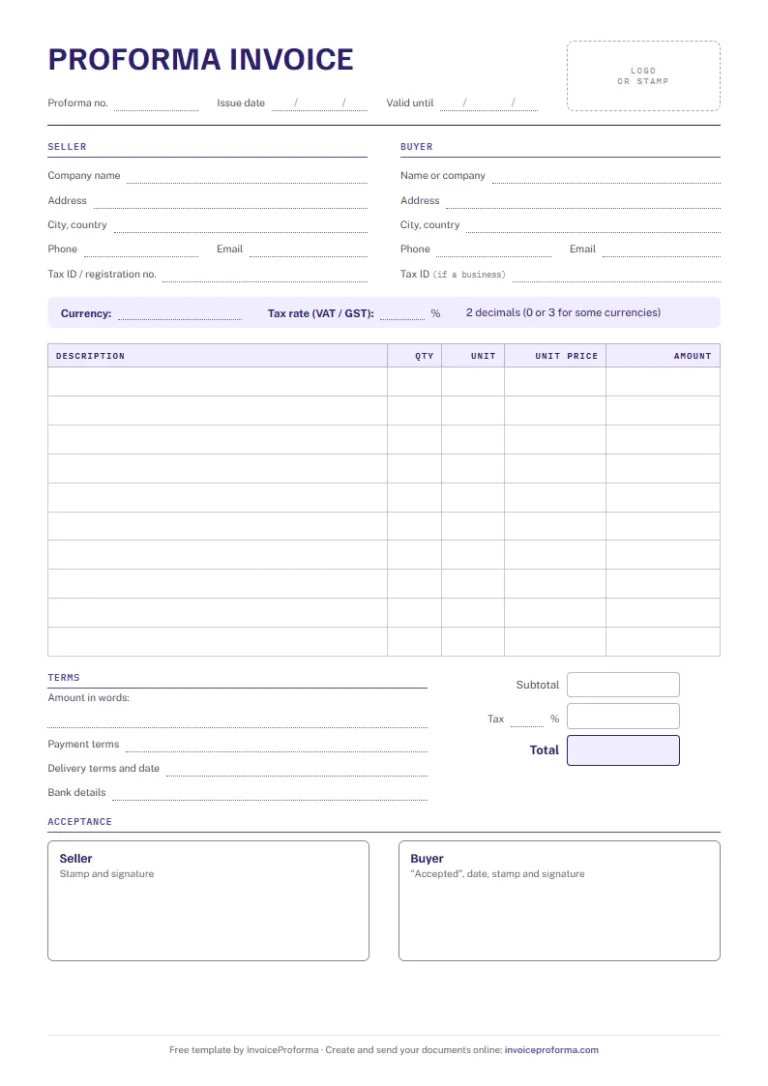
How a documentary credit works, the documents banks examine, why presentations are refused, and how to word your proforma so the credit is workable.
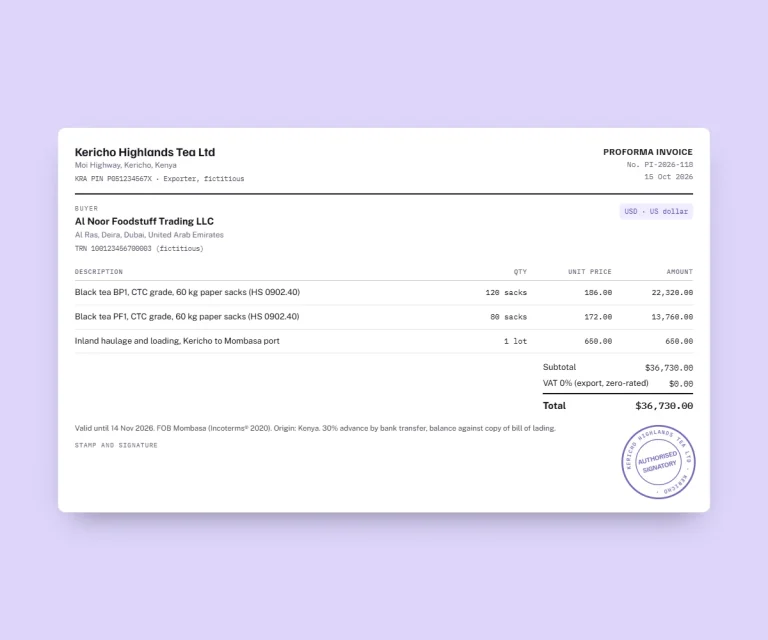
FOB or CIF, which supplier is really cheaper? A worked landed cost calculation with duty, freight, destination charges and the costs importers forget.
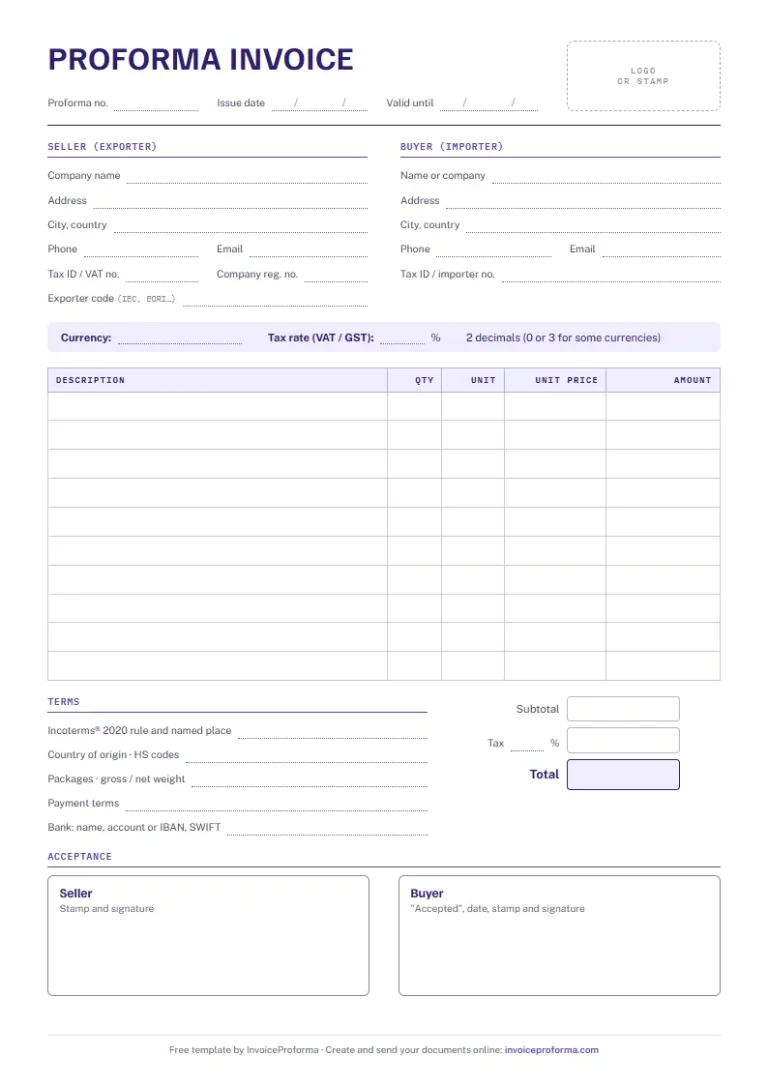
Commercial invoice, packing list, bill of lading, certificate of origin and destination-specific papers, with the consistency rules that prevent port delays.
Six documents, one app
From the quote to the receipt
One customer file, one product list and your own layout serve all six documents. An accepted quote or proforma becomes an invoice without retyping.
1. The price
Quote
QUO-2026-0012
Your price for the job, with a validity date and space for the buyer to accept it.
2. The firm offer
Proforma invoice
PI-2026-042
What your buyer’s bank, their forwarder or their purchasing team asks for before the order.
3. The order
Purchase order
PO-2026-0007
What is ordered, how many and for which delivery date, signed by the buyer.
4. The delivery
Delivery note
DN-2026-0007
It travels with the goods; the consignee signs it and writes down any reservation.
5. The sale
Invoice
INV-2026-0031
The accepted proforma or quote becomes the invoice, with the same lines and currency.
6. The payment
Payment receipt
REC-2026-0019
Proof of a payment, linked to its invoice, with the method and the balance still due.
3 free documents to try it, no card required.
Your next proforma invoice, already in your colours
Three free documents, no card required. Your tax IDs, bank details and payment terms are typed once, then printed on every PDF.