Guide · Classification
HS Codes Explained
Every product crossing a border is reduced to a number. That number — the Harmonized System code — decides the duty rate, the import taxes, whether a licence is needed, whether a quota applies and whether the goods can enter at all. Get it right and your buyer can calculate landed cost from your proforma invoice alone. Get it wrong and the shipment is reclassified at destination, usually upwards.
Updated 17 October 2026 · 5 min read
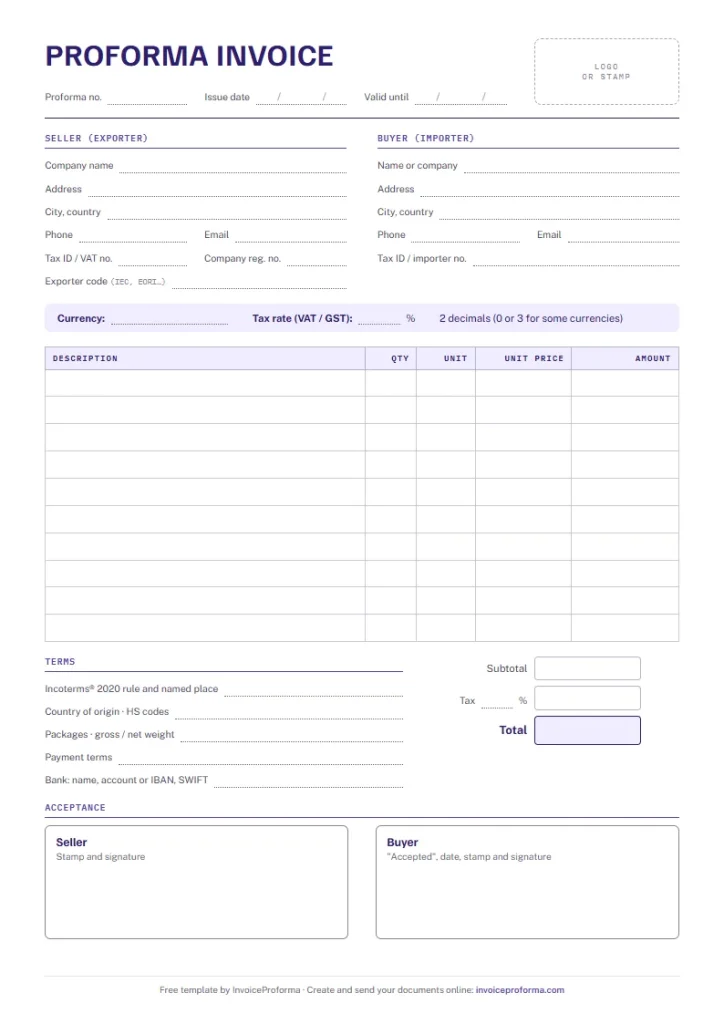
From the guide to the document
Your proforma with these details, ready as a PDF.
What the Harmonized System is
The Harmonized Commodity Description and Coding System is maintained by the World Customs Organization and used by more than 200 countries and customs unions. It covers essentially all traded goods and is revised every five years, which is why you will hear people refer to HS 2017, HS 2022 or HS 2028 editions. The first six digits are identical worldwide. Everything beyond six digits is national.
That split is the single most useful thing to understand. When you tell a buyer in Kenya that your product is 8481.80, you are speaking a language their customs system understands exactly. When you quote a ten-digit code from your own country’s tariff, you are speaking a dialect that means nothing to them.
How a code is built
Take stainless steel ball valves, classified under 8481.80. The code decomposes like this:
| Level | Digits | Example | Meaning |
|---|---|---|---|
| Section | Roman numeral, not in the code | Section XVI | Machinery and mechanical appliances — 21 sections in total |
| Chapter | 2 | 84 | Nuclear reactors, boilers, machinery and mechanical appliances |
| Heading | 4 | 8481 | Taps, cocks, valves and similar appliances |
| Subheading | 6 | 8481.80 | Other appliances — internationally identical |
| National tariff line | 8, 10 or more | 8481.80.79 (EU CN) / 8481.80.5090 (US HTSUS) | Country-specific duty, quota and statistical detail |
Common national extensions: the European Union uses an 8-digit Combined Nomenclature, extended to 10 digits in TARIC for measures such as anti-dumping duties and suspensions; the United States uses the 10-digit HTSUS for imports and Schedule B for export declarations; the United Kingdom uses 10 digits; China uses 13 digits, of which the last four carry regulatory and CIQ information; India uses the 8-digit ITC (HS).
Chapters you will meet most often
| Chapter | Covers | Typical classification trap |
|---|---|---|
| 09 | Coffee, tea, spices | Roasted vs unroasted, decaffeinated or not, changes the heading |
| 39 | Plastics and articles of plastic | Primary forms (39.01–39.14) vs finished articles (39.15–39.26) |
| 44 | Wood and wood articles | Species and treatment drive phytosanitary requirements as well as duty |
| 61 / 62 | Apparel — knitted (61) vs woven (62) | Construction, not appearance, decides the chapter; then fibre composition decides the heading |
| 72 / 73 | Iron and steel, and articles thereof | Semi-finished vs finished; safeguard measures apply to many lines |
| 84 | Machinery | Machines with an individual function vs parts of machines (see Section XVI notes) |
| 85 | Electrical machinery and electronics | Battery-powered and wireless features often move the code entirely |
| 87 | Vehicles and parts | Parts classification is heavily rule-driven and audited |
| 94 | Furniture, lighting, prefabricated buildings | Material and function both matter; seats have their own heading, 9401 |
The rules that decide a disputed classification
Classification is not a matter of opinion. Six General Rules of Interpretation are applied in order, and a customs officer anywhere in the world uses the same six.
- Rule 1. Classification is determined by the terms of the headings and by the section and chapter notes. The notes outrank intuition — read them first.
- Rule 2. Incomplete or unassembled articles are classified as the finished article if they have its essential character. Mixtures and combinations extend to materials of that kind.
- Rule 3. When two headings could apply: (a) the most specific description wins; (b) failing that, the material or component giving the goods their essential character; (c) failing that, the heading appearing last in numerical order.
- Rule 4. Goods that fit nowhere go with the goods to which they are most akin — rarely used.
- Rule 5. Cases and packing presented with the goods usually follow the goods; packing for repeated use is classified separately.
- Rule 6. Subheadings are compared only with subheadings at the same level, applying the rules above.
Rule 3(b) — essential character — is where most real disputes are decided. A gift set containing a mug, a spoon and a packet of coffee is not classified three times; it is classified by whichever component gives it its essential character.
How to find the right code for your product
- Describe the goods properly first. Material, function, how it is made, whether it is powered, how it is presented for retail sale, and its state of processing. A one-line product name is not enough to classify anything.
- Find the chapter, then read the chapter notes. Exclusions in the notes eliminate whole branches quickly and save hours.
- Work down to the six-digit subheading using the official nomenclature and the explanatory notes, not a search engine.
- Check the destination country’s tariff for the full national line, the applicable duty and any licences, quotas or anti-dumping measures. Most customs administrations publish an online tariff browser.
- Verify against published decisions. The EU publishes Binding Tariff Information; US Customs publishes binding rulings in its CROSS database. If a competitor’s identical product has a ruling, you have your answer.
- For high-volume or high-duty goods, apply for a binding ruling of your own. It is free or inexpensive, takes weeks to months, and protects you against a retroactive assessment.
Who is legally responsible for the code?
On import, the declarant — normally the importer or their customs broker — is responsible, and penalties for a wrong declaration fall on them. That does not let the exporter off. If your proforma invoice carries a code the buyer relies on and it is wrong, you will be dealing with a reclassification claim, a demand for the duty difference, and a buyer who has lost confidence. State the code as the classification you use in your own country, and invite the importer to confirm it against their national tariff. That sentence on the document has saved a great many relationships.
HS codes and preferential origin
Free trade agreements grant reduced duty only if the goods meet the origin rule for their tariff heading. Many of those rules are expressed as a “change in tariff heading”: if the imported inputs are classified in a different four-digit heading from the finished product, the transformation is deemed substantial and the goods qualify. That makes the HS code the foundation of your origin claim, not just a duty lookup. If you issue certificates of origin, EUR.1 movement certificates or self-declarations, the code on the proforma, the commercial invoice and the certificate must be identical — see the export documents checklist.
Putting the code on your proforma invoice
Show the six-digit HS subheading on every line, next to the description and the country of origin. Where a destination has a specific tariff line that matters — an anti-dumping measure, a quota, a licence requirement — mention it in the notes. Buyers who deal with letters of credit will also expect the code to appear on the commercial invoice and, sometimes, in the credit itself.
Continue with what a proforma invoice must contain, choose your delivery terms in the Incoterms 2020 guide, see how the code feeds a landed cost calculation, or create a proforma invoice online and write the HS code in each line’s description.
This page explains how classification works. It is general information, not a binding tariff opinion. Confirm the final code with the customs authority of the country of import or with a licensed customs broker.
Read next
Related guides
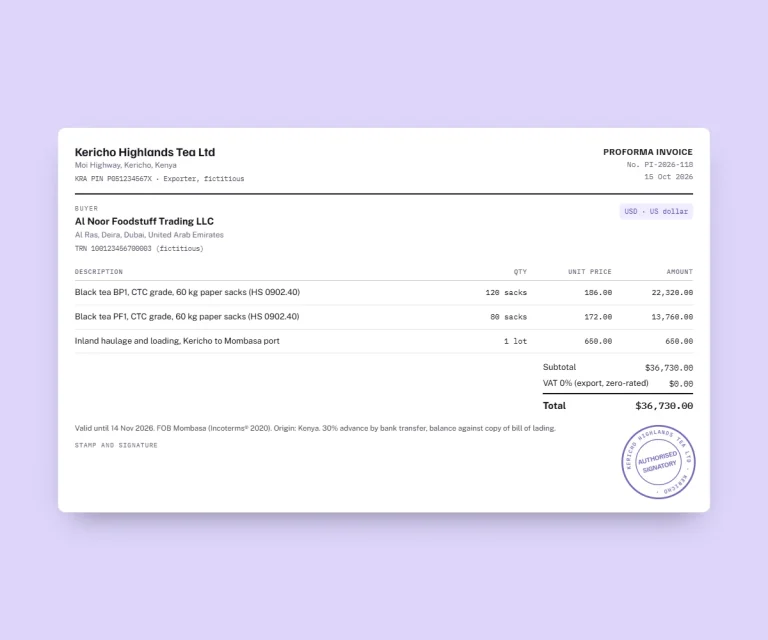
Customs clears goods on the commercial invoice, but proformas are accepted for licences, samples, temporary admission and free-of-charge shipments.
FOB or CIF, which supplier is really cheaper? A worked landed cost calculation with duty, freight, destination charges and the costs importers forget.
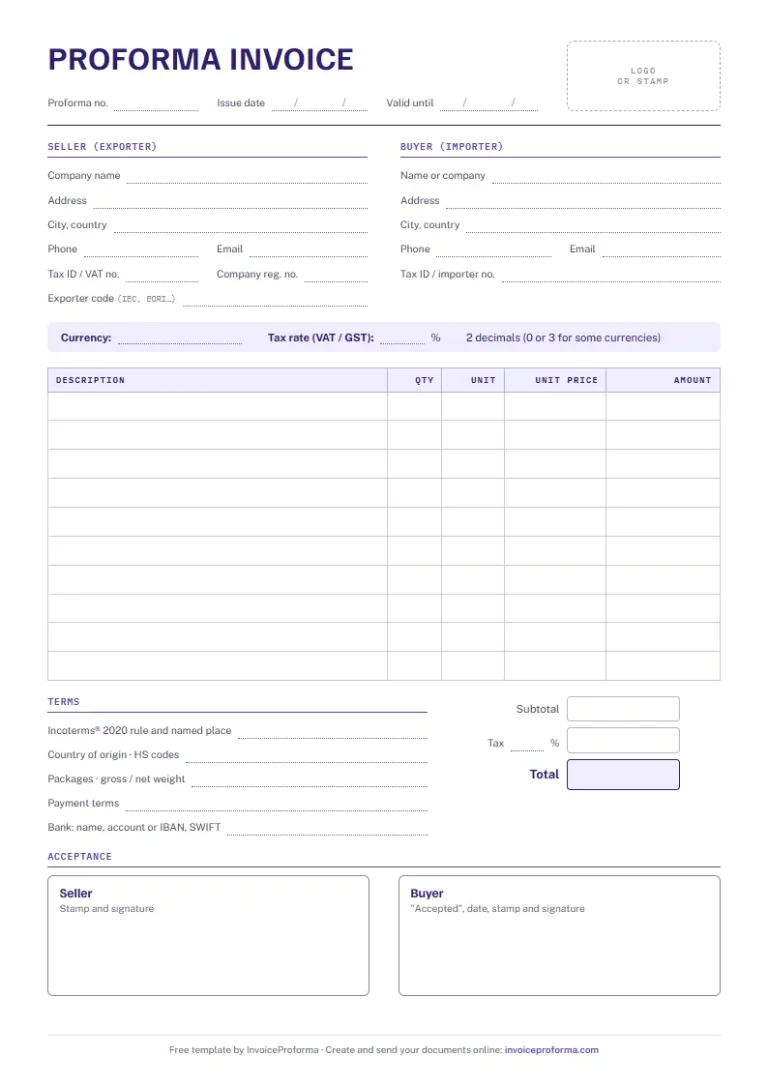
Non-preferential vs preferential origin, who issues the certificate, what it must match on your invoice, and the errors that trigger duty demands.
Six documents, one app
From the quote to the receipt
One customer file, one product list and your own layout serve all six documents. An accepted quote or proforma becomes an invoice without retyping.
1. The price
Quote
QUO-2026-0012
Your price for the job, with a validity date and space for the buyer to accept it.
2. The firm offer
Proforma invoice
PI-2026-042
What your buyer’s bank, their forwarder or their purchasing team asks for before the order.
3. The order
Purchase order
PO-2026-0007
What is ordered, how many and for which delivery date, signed by the buyer.
4. The delivery
Delivery note
DN-2026-0007
It travels with the goods; the consignee signs it and writes down any reservation.
5. The sale
Invoice
INV-2026-0031
The accepted proforma or quote becomes the invoice, with the same lines and currency.
6. The payment
Payment receipt
REC-2026-0019
Proof of a payment, linked to its invoice, with the method and the balance still due.
3 free documents to try it, no card required.
Your next proforma invoice, already in your colours
Three free documents, no card required. Your tax IDs, bank details and payment terms are typed once, then printed on every PDF.