Guide · Origin
Certificate of Origin: Types, Issuers and Common Mistakes
A certificate of origin answers a question customs asks about every consignment: where were these goods actually made? The answer decides the duty rate, whether a quota or an anti-dumping measure applies, and sometimes whether the goods may enter at all. It is also one of the documents most often produced incorrectly, because “origin” in customs law has almost nothing to do with the address of the seller.
Updated 17 October 2026 · 3 min read
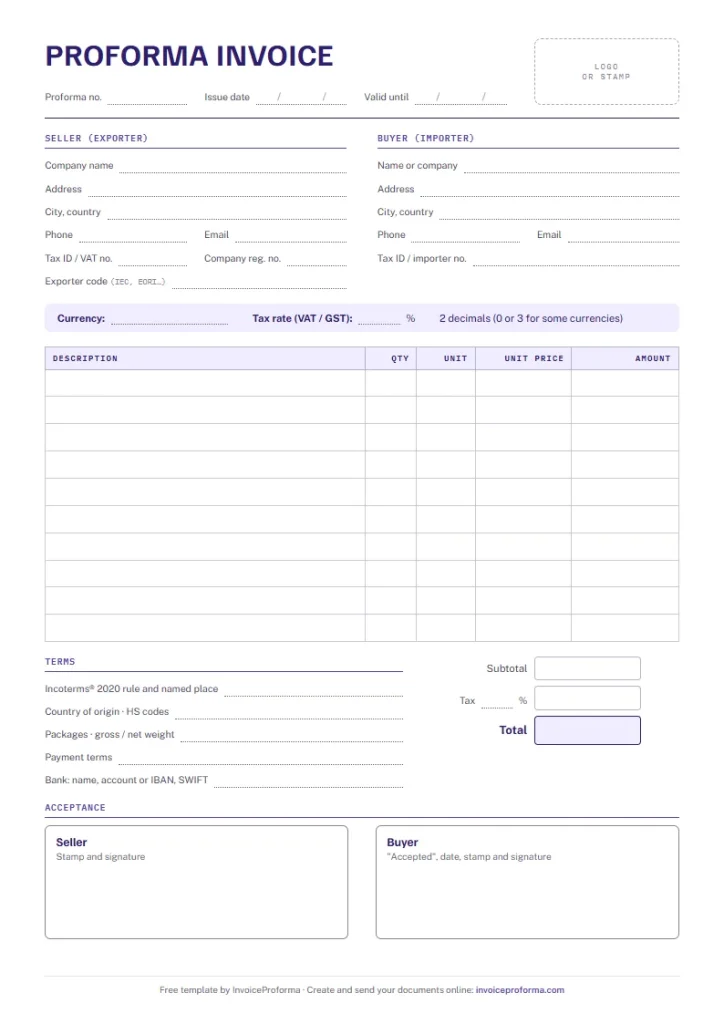
From the guide to the document
Your proforma with these details, ready as a PDF.
Origin is not where you shipped from
Goods manufactured in Vietnam, sold by a trading company in Singapore and shipped from Malaysia are Vietnamese in origin. The invoice address, the port of loading and the flag of the vessel are irrelevant. Origin is determined by where the goods were wholly obtained or, when more than one country was involved, where they underwent their last substantial transformation.
“Substantial transformation” is usually tested in one of three ways: a change in tariff classification — the finished product falls in a different HS heading from its imported inputs; a value-added threshold — local content exceeds a stated percentage; or a specific processing rule for that product. Which test applies depends on the rules that govern the claim. That is why the HS code sits at the centre of any origin determination; see the HS code guide.
Non-preferential and preferential origin
| Non-preferential | Preferential | |
|---|---|---|
| Purpose | Statistics, labelling, quotas, anti-dumping, embargoes, public procurement | Claiming a reduced or zero duty rate under a trade agreement |
| Rules applied | The importing country’s general origin rules | The specific rules of the agreement being used |
| Typical document | Certificate of origin issued by a chamber of commerce | Movement certificate, or a statement on origin made by an approved or registered exporter |
| Effect if wrong | Possible penalty, wrong measure applied | Retroactive duty demand on the importer, plus interest and possibly penalties |
The distinction matters commercially. A generic certificate of origin proves the goods are, say, Egyptian. It does not by itself entitle the importer to a preferential rate under an agreement — that requires the correct preferential document and goods that genuinely satisfy the agreement’s rule of origin.
Who issues what
- Chambers of commerce issue and stamp the ordinary certificate of origin, usually on the basis of an application, the commercial invoice and evidence of manufacture. Many now issue electronically with a verification code.
- Customs authorities issue or endorse movement certificates used under several agreements, such as EUR.1 and ATR.
- The exporter can, under many modern agreements, make the origin claim itself — as a statement on origin on the invoice, subject to registration or approval and to keeping supporting records.
- Consulates and embassies still legalise documents for certain destinations, adding time and cost that must be built into your lead time.
What the certificate must agree with
Banks and customs officers compare documents line by line. The certificate must match the commercial invoice — and therefore the proforma invoice it came from — on all of the following:
- Exporter and consignee names and addresses, spelled identically
- Description of goods, including model and grade
- HS codes
- Quantities, package counts, marks and numbers
- Invoice number and date
- Country of origin stated unambiguously — not “EU” where a specific member state is required
Under a documentary credit, a mismatch here is a discrepancy and the bank may refuse the presentation; see letters of credit for small exporters.
Practical mistakes
- Declaring the country of dispatch as the origin. Common with trading companies, and it is exactly what verification procedures are designed to catch.
- Claiming preference without checking the rule. Assembly from imported components frequently fails the tariff-shift test. The importer pays for the error, and then stops buying from you.
- Applying for the certificate after the goods have shipped. Some chambers will not backdate, and a credit may require the certificate to be dated no later than the transport document.
- Mixed-origin consignments on one certificate without stating which line is which. Show the origin per line, as on our proforma invoice template.
- Forgetting legalisation. Where a destination requires consular attestation, budget days, not hours.
- Discarding the evidence. Keep bills of materials, supplier declarations and production records for the retention period — verification requests arrive years later, and an unsupported claim is treated as no claim.
Getting it right from the proforma stage
Decide the origin before you quote, not when the chamber asks for the application. State it per line on the proforma invoice, tell the buyer which preferential regime you can support, and confirm what documentary form they need — a movement certificate, a statement on origin, or an ordinary certificate. If preference is not available, say so early: the buyer’s landed cost calculation depends on it, and a surprise at clearance is remembered far longer than a lower price.
Related: the export documents checklist, country import requirements, and proforma invoices for customs clearance. To issue your proforma and invoice online, create a free account, and write the origin and HS code next to each item.
Origin rules differ between agreements and change over time. This article is general information; confirm your determination with the issuing chamber, your customs authority or a licensed customs broker before making a preferential claim.
Read next
Related guides
How Harmonized System codes are built, what the six digits mean, the rules that settle classification disputes, and a practical method for finding your code.
Commercial invoice, packing list, bill of lading, certificate of origin and destination-specific papers, with the consistency rules that prevent port delays.
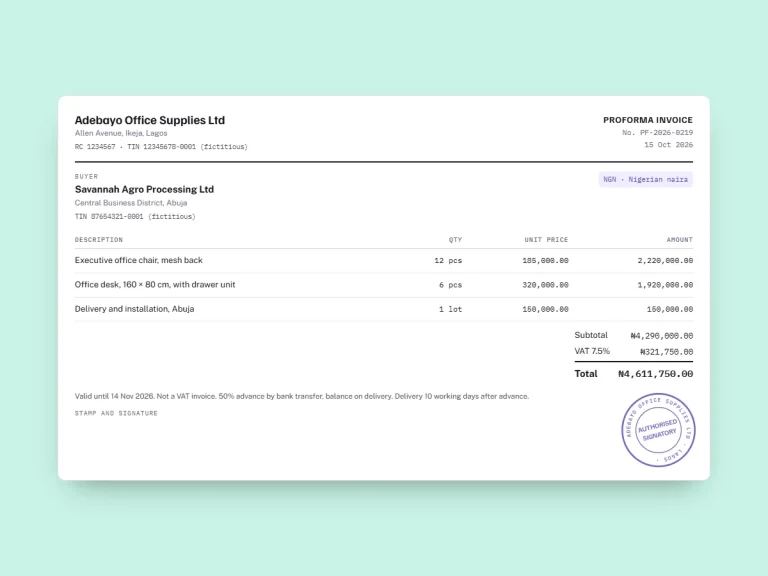
What the EU, US, Gulf, Nigeria, Kenya, North Africa and India expect before shipment: licences, exchange control and pre-shipment inspection.
Six documents, one app
From the quote to the receipt
One customer file, one product list and your own layout serve all six documents. An accepted quote or proforma becomes an invoice without retyping.
1. The price
Quote
QUO-2026-0012
Your price for the job, with a validity date and space for the buyer to accept it.
2. The firm offer
Proforma invoice
PI-2026-042
What your buyer’s bank, their forwarder or their purchasing team asks for before the order.
3. The order
Purchase order
PO-2026-0007
What is ordered, how many and for which delivery date, signed by the buyer.
4. The delivery
Delivery note
DN-2026-0007
It travels with the goods; the consignee signs it and writes down any reservation.
5. The sale
Invoice
INV-2026-0031
The accepted proforma or quote becomes the invoice, with the same lines and currency.
6. The payment
Payment receipt
REC-2026-0019
Proof of a payment, linked to its invoice, with the method and the balance still due.
3 free documents to try it, no card required.
Your next proforma invoice, already in your colours
Three free documents, no card required. Your tax IDs, bank details and payment terms are typed once, then printed on every PDF.