Guide · Comparison
Proforma Invoice vs Commercial Invoice
Both documents list the same goods, the same buyer and often the same total. Only one of them is an accounting record, and only one of them will be used by customs to assess duty. Sending the wrong one — or sending two versions that contradict each other — is one of the most common causes of delayed shipments and rejected letter-of-credit presentations.
Updated 17 October 2026 · 4 min read
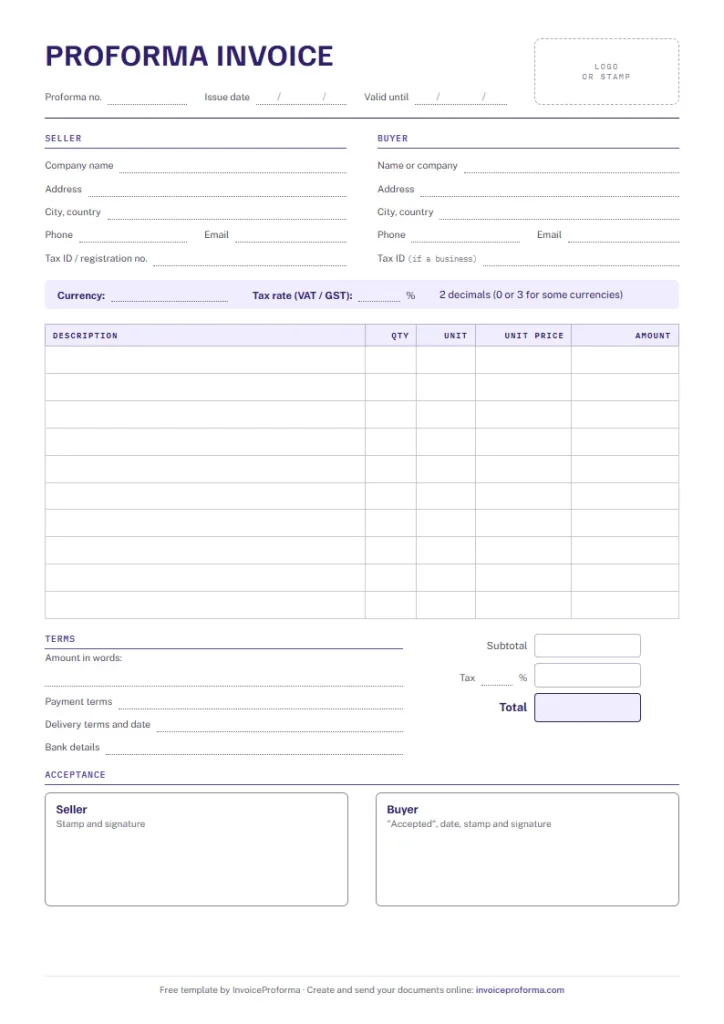
From the guide to the document
Your proforma with these details, ready as a PDF.
The one-sentence difference
A proforma invoice is issued before the sale is agreed and says “this is what I will supply, on these terms”. A commercial invoice is issued after the goods are ready to ship and says “this is what I have supplied, and this is what you owe me”. The first is an offer; the second is a claim.
Side-by-side comparison
| Criterion | Proforma invoice | Commercial invoice |
|---|---|---|
| Moment of issue | Before the order is confirmed, sometimes before production starts | When the goods are ready or already shipped |
| Legal nature | An offer; becomes binding when accepted | Evidence of a completed sale |
| Accounting | Not recorded; creates no receivable | Recorded in the sales ledger; creates a receivable |
| Tax treatment | Not a tax document; not reported for VAT/GST | Tax document; supports VAT/GST and export zero-rating |
| Numbering | Separate series, e.g. PI-2026-041 | Sequential legal invoice series, e.g. INV-2026-0187 |
| Customs valuation | Not normally accepted for a definitive import | The valuation document under WTO rules |
| Used by the buyer’s bank | Yes — to open a letter of credit or approve a transfer | Yes — presented as a required document under the credit |
| Used for an import licence | Yes, this is its primary role in many markets | Sometimes, at the clearance stage |
| Payment obligation | None until accepted; a deposit may be requested against it | Payable per the stated terms |
| Can it be amended? | Freely, by issuing a new version before acceptance | Only by credit note or a corrected invoice, with an audit trail |
| Expiry | Yes — a validity date is expected | No expiry; a due date instead |
| Signature and stamp | Commonly required by importers and licensing bodies | Often required for certificates of origin and legalisation |
Where the documents overlap
The fields below must be identical on both documents. Any divergence is a discrepancy under a letter of credit and a query at customs.
- Legal names and addresses of seller and buyer, plus consignee and notify party where they differ
- Description of goods, word for word — including grade, model, composition and packing
- HS code for each line, and the country of origin
- Quantity, unit of measure, unit price and currency
- The Incoterms 2020 rule and the named place
- Port of loading and port of discharge
- Any allowances, discounts, freight and insurance shown separately
Under UCP 600, the invoice presented under a documentary credit must describe the goods in a way that corresponds with the description in the credit — and the credit was written from your proforma. This is why a careless proforma description turns into a rejected presentation months later. See letters of credit for small exporters.
When to send which
Send a proforma invoice when
- The buyer asks for a “PI” — universal shorthand in trade for exactly this document
- The buyer must open a letter of credit or obtain foreign-exchange approval
- An import licence, Form M, IDF or equivalent registration is required at destination
- You want a deposit before starting production
- You are shipping samples, replacements under warranty, or goods for exhibition — movements with no sale
- The buyer’s procurement process needs a formal document to raise a purchase order against
Send a commercial invoice when
- The goods are packed, booked and about to leave
- The forwarder needs the export declaration filed
- Documents must be presented to the bank under a credit or a documentary collection
- The importer’s broker is preparing the entry at destination
- You need to recognise the sale in your accounts and support export zero-rating
A typical sequence on a container shipment
- Day 0. Enquiry received. You issue proforma invoice PI-2026-041, CFR Mombasa, Incoterms 2020, valid 30 days, 30% deposit and balance against a letter of credit at sight.
- Day 6. Buyer signs the proforma and lodges it with their bank to apply for the import declaration form and the credit.
- Day 18. The credit is advised to you. You check that the goods description, the latest shipment date and the required documents match your proforma — before production, not after.
- Day 40. Goods are ready. You issue commercial invoice INV-2026-0187 quoting PI-2026-041, with identical line items, and prepare the packing list and certificate of origin.
- Day 44. Goods loaded, bill of lading issued, documents presented to the bank within the presentation period.
The whole sequence works only if step 4 is a faithful copy of step 1. If you generate the commercial invoice from the accepted proforma rather than retyping it, you remove the most common source of discrepancy.
Frequent errors
| Error | Consequence | Fix |
|---|---|---|
| Same number series for both documents | Duplicate payments, broken audit trail | Prefix proformas (PI-) and keep a separate counter |
| Proforma sent to customs as the entry invoice | Entry rejected or held; possible penalty for an incorrect declaration | Always issue the commercial invoice for a definitive import |
| Commercial invoice totals differ from the credit amount | Discrepancy; payment delayed or refused | Reconcile against the credit before shipping, not after |
| Missing “Proforma Invoice” title | Buyer’s payables team pays it, then pays the real invoice too | Title the document explicitly and add “This is not a tax invoice” |
| Different Incoterms rule on the two documents | Dispute over freight and insurance costs; customs value questioned | Lock the rule at proforma stage; see the Incoterms 2020 guide |
Does a proforma invoice ever replace a commercial invoice?
In three situations, in practice: shipments with no commercial transaction (samples of no commercial value, warranty replacements, goods returned for repair), temporary admissions such as exhibition equipment, and low-value personal or gift consignments where the courier’s system accepts a proforma stating “value for customs purposes only”. Even then, some customs administrations will insist on their own valuation. Everywhere else, the commercial invoice is the document of record — see proforma invoices for customs clearance for the detail.
Practical takeaway
Treat the proforma as the master document of the transaction. Get the description, the HS codes, the origin and the Incoterms rule right at that stage, then propagate them to the commercial invoice, the packing list and the certificate of origin without retyping. Our export documents checklist shows how the set fits together, and you can turn the accepted proforma into the invoice in one click, with the same lines, so the figures cannot drift.
Read next
Related guides
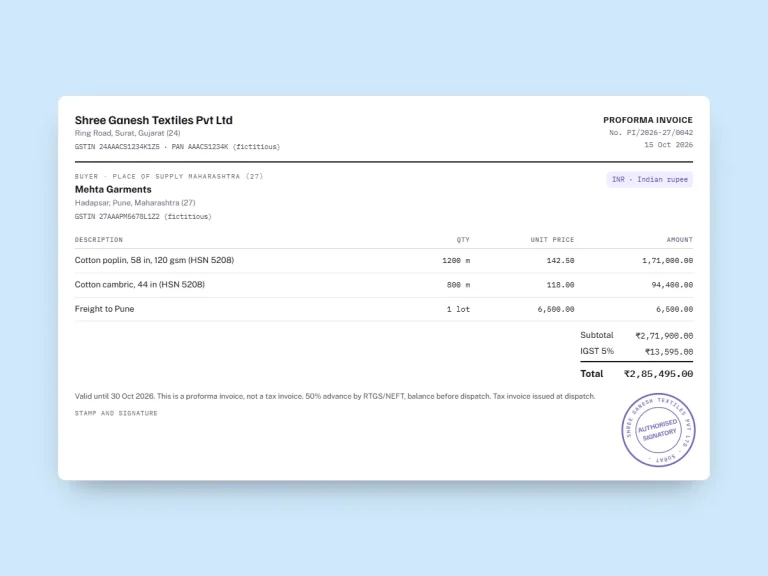
A proforma invoice is an offer; an invoice is a demand for payment. Legal effect, tax, accounting and numbering compared, with a table and examples.
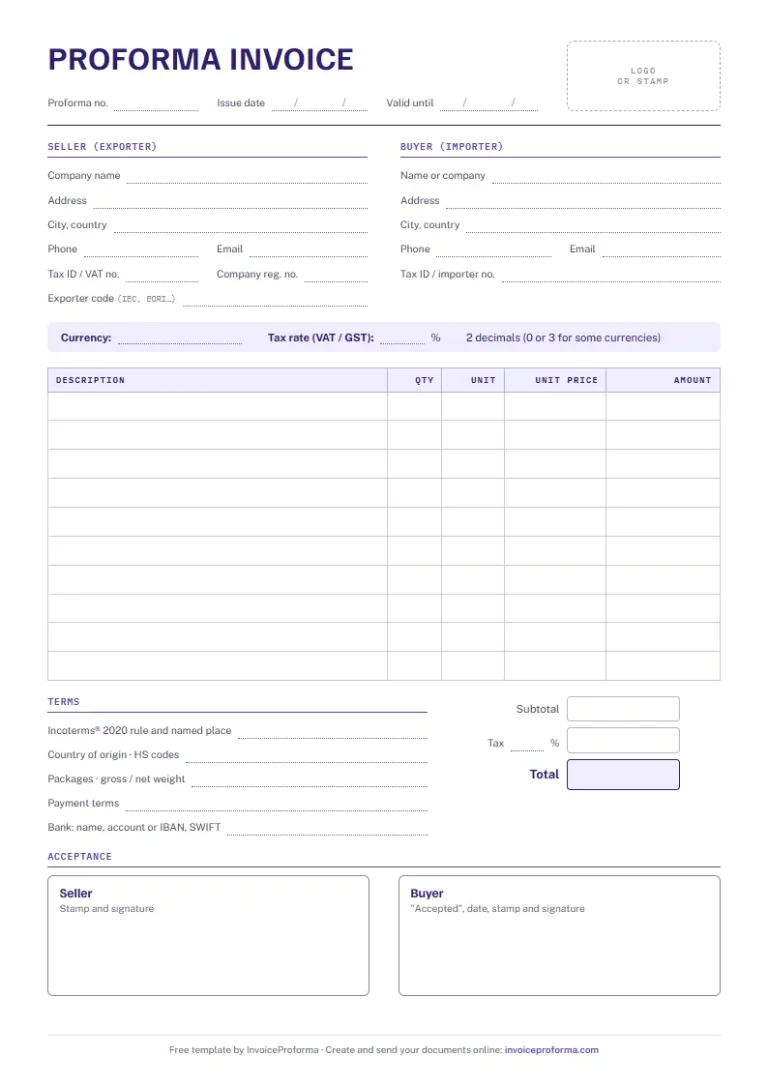
Commercial invoice, packing list, bill of lading, certificate of origin and destination-specific papers, with the consistency rules that prevent port delays.
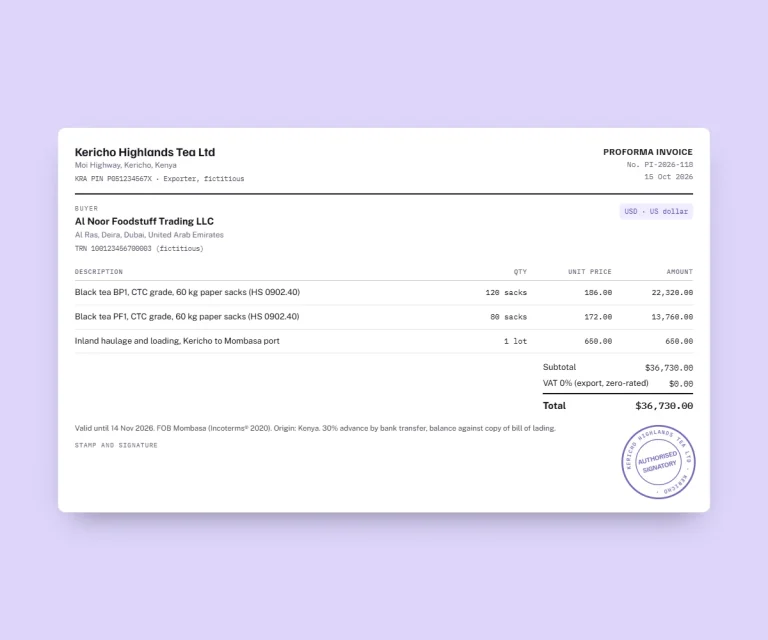
Customs clears goods on the commercial invoice, but proformas are accepted for licences, samples, temporary admission and free-of-charge shipments.
Six documents, one app
From the quote to the receipt
One customer file, one product list and your own layout serve all six documents. An accepted quote or proforma becomes an invoice without retyping.
1. The price
Quote
QUO-2026-0012
Your price for the job, with a validity date and space for the buyer to accept it.
2. The firm offer
Proforma invoice
PI-2026-042
What your buyer’s bank, their forwarder or their purchasing team asks for before the order.
3. The order
Purchase order
PO-2026-0007
What is ordered, how many and for which delivery date, signed by the buyer.
4. The delivery
Delivery note
DN-2026-0007
It travels with the goods; the consignee signs it and writes down any reservation.
5. The sale
Invoice
INV-2026-0031
The accepted proforma or quote becomes the invoice, with the same lines and currency.
6. The payment
Payment receipt
REC-2026-0019
Proof of a payment, linked to its invoice, with the method and the balance still due.
3 free documents to try it, no card required.
Your next proforma invoice, already in your colours
Three free documents, no card required. Your tax IDs, bank details and payment terms are typed once, then printed on every PDF.