Questions
Proforma invoice FAQ: what exporters and importers ask
Answers to the questions exporters, importers and freight forwarders ask most often about proforma invoices, customs documents and international payment terms. Another question? Write to us from the contact page.
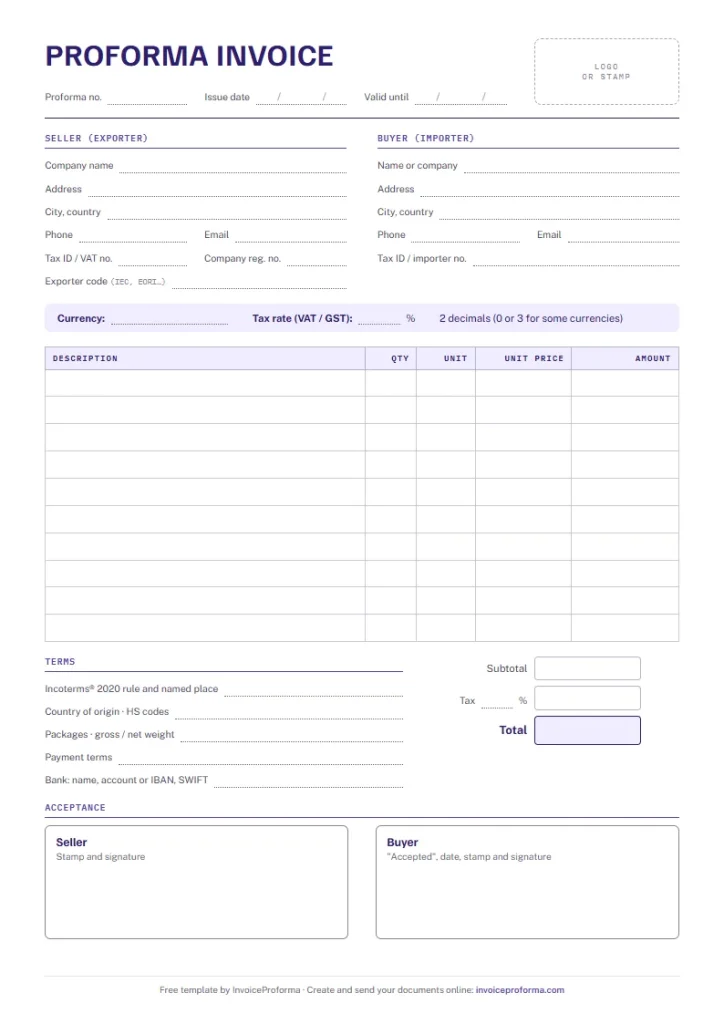
The proforma invoice
What is a proforma invoice?
A proforma invoice is a written offer to sell, presented in the layout of an invoice. It sets out the goods, quantities, unit prices, delivery terms, payment terms and validity before the sale is concluded. It creates no receivable, is not a tax document, and is not recorded in your accounts. In international trade it is the document a buyer uses to open a letter of credit, apply for an import licence or obtain foreign-exchange approval. The full explanation is in our guide to what a proforma invoice is.
Is a proforma invoice legally binding?
By itself, no. It is an offer, and an offer can be withdrawn before it is accepted or after its validity date passes. Once the buyer accepts it — by signing and stamping it, by paying the deposit it states, or by instructing their bank to open a credit that refers to it — its terms generally become the terms of the sale contract. That is why the description of goods, the Incoterms rule and the validity date must be written carefully.
Can I use a proforma invoice for customs clearance?
For a definitive commercial import, usually not: customs values goods on the transaction value evidenced by the commercial invoice. Proformas are widely accepted for import licence and foreign-exchange applications, for samples of no commercial value, for temporary admissions such as exhibition goods, for warranty replacements and for goods sent for repair. Details, including corridor-specific practice, are in proforma invoices for customs clearance.
What is the difference between a proforma invoice and a commercial invoice?
Timing and legal effect. The proforma is issued before the sale is agreed and commits nobody to pay; the commercial invoice is issued when the goods ship, records the sale in both companies’ books and is the customs valuation document. They should contain the same goods description, HS codes, origin, currency and Incoterms rule. The full comparison table is in proforma invoice vs commercial invoice.
How long should a proforma invoice be valid?
Between 15 and 90 days, depending on your price exposure and on your buyer’s paperwork. Fifteen days is reasonable where raw material or freight costs move quickly. Sixty days or more is often necessary when the importer must obtain a licence or open a letter of credit, because those processes take weeks. State the validity explicitly; many licensing authorities reject an offer that does not carry one.
Customs, banks and trade terms
Do I have to put an HS code on my proforma invoice?
It is not always legally required, but omitting it is a false economy. The HS code determines duty, taxes, licences and prohibitions at destination, and without it your buyer cannot calculate landed cost or complete their import file. Give the six-digit international subheading for each line and note which country’s tariff you used. See the HS code guide.
Which Incoterms rule should a first-time exporter choose?
FCA at a named place is usually the safest starting point: you handle export clearance, which only you can do, and the buyer’s forwarder takes over from there. Avoid EXW, which obliges a foreign buyer to file an export declaration in your country and leaves you without proof of export. Avoid DDP unless you have confirmed you can act as importer of record at destination. The 11 rules, with a worked cost example, are in the Incoterms 2020 guide.
Why does my buyer's bank need my proforma invoice?
Because the letter of credit is drafted from it. The bank copies your goods description, amount, currency, Incoterms rule, shipment period and required documents into the credit. Anything vague or wrong in your proforma becomes vague or wrong in the credit, and your shipping documents will later be examined against that text. See letters of credit for small exporters.
Should proforma invoices use the same numbering as my invoices?
No. Use a separate series with a distinct prefix, such as PI-2026-041. Sharing the sequence with your legal invoice numbering breaks the audit trail, confuses your buyer’s accounts payable team and can lead to a document being paid twice. Add a line stating that the document is not a tax invoice and that no payment is due against it.
Does a proforma invoice need a signature and a stamp?
Legally, rarely. Practically, yes. Banks and licensing authorities in many markets — particularly where exchange controls apply — will not accept an unsigned or unstamped document, and a signature reassures a new buyer that the offer is genuine. Sign it, stamp it, and export it as a PDF rather than an editable file.
Can a proforma invoice be issued in any currency?
Yes, provided the currency is stated clearly and your buyer can obtain it. US dollars and euros dominate cross-border trade, but some markets restrict which currencies can be remitted, and a licence or bank registration may lock the currency for the whole transaction. Agree it before issuing, because changing it later usually means amending the buyer’s licence or credit, not just reissuing your document.
Do I charge VAT or sales tax on a proforma invoice?
Exports of goods are commonly zero-rated or exempt, but the rule depends on your own country’s law and on your ability to prove the goods left. A proforma is not a tax document in any case, so it should show the tax treatment you intend to apply rather than charge tax. Confirm the position with your accountant and keep your export declaration and transport documents as evidence.
What is the difference between a quotation and a proforma invoice?
A quotation is a commercial, often informal price indication addressed to a purchasing manager. A proforma invoice is a firm offer laid out as an invoice, complete enough to be lodged with a bank or a government authority. In practice, buyers in international trade ask for a “PI” precisely because their bank or their customs regime needs the fuller document.
InvoiceProforma
Is InvoiceProforma free?
The Free plan includes 3 documents, with no card required and no time limit. The Pro plan removes the limit for one year for USD 7, paid once by PayPal. Details on the pricing page.
Can I convert a proforma into an invoice?
Yes, in one click. The invoice takes the buyer, the lines, the terms and the currency of the proforma, and gets a number from your invoice series. The two numbering series stay separate.
Which currencies can I use?
You choose the currency of each document among 52, from the US dollar, euro and pound to the rupee, naira, shilling, rand or dirham. Amounts are rounded to the decimals of the currency: 0, 2 or 3.
Where do I put my HS codes and Incoterms rule?
The app has no dedicated fields for them. Write the HS code and origin in each line’s description, and the Incoterms rule with its named place in the document note; both print on the PDF. Your tax IDs and exporter code go in your company profile, once.
Can I issue the document in English and my buyer's language?
The PDF follows the language of the interface: English, French, Spanish or Italian. Switch the language before downloading to produce the same document in another language.
Where is my data hosted?
The website and the application are hosted by Contabo GmbH in Germany. You can ask for your account and data to be deleted at contact@invoiceproforma.com. See the privacy policy.
Does the site provide customs or legal advice?
No. The guides here explain how documents and trade rules generally work, so that you can ask better questions. Classification, valuation, licensing and tax decisions should be confirmed with the customs authority of the country of import, a licensed customs broker, your bank’s trade finance desk or a qualified adviser.
Your next proforma invoice, already in your colours
Three free documents, no card required. Your tax IDs, bank details and payment terms are typed once, then printed on every PDF.