Guide · Import rules
Country Import Requirements by Trade Corridor
The same proforma invoice can be a formality in one market and the gatekeeper of the entire transaction in another. This guide walks through the trade corridors exporters ask about most often, and what each destination expects to see on the documents before goods can be paid for, licensed and cleared.
Updated 17 October 2026 · 5 min read
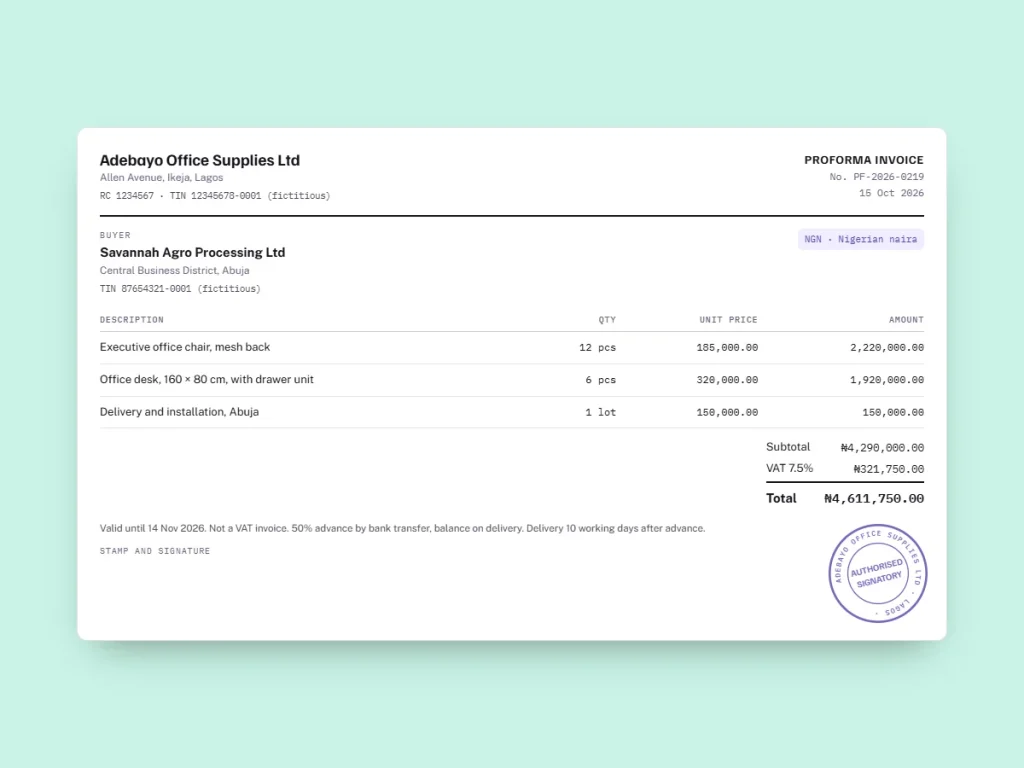
From the guide to the document
Your proforma with these details, ready as a PDF.
Two questions decide how much work a corridor will be. First, does the country operate exchange controls? If yes, the importer must register the transaction with a bank before money moves, and your proforma is the input to that registration. Second, does the country require pre-shipment conformity assessment? If yes, an inspection must happen in your country before the goods leave — arranging it after loading is impossible.
European Union
A relatively light corridor on paper. The importer needs an EORI number and, for most goods, nothing more than a commercial invoice, packing list and transport document to lodge the declaration. Import VAT is due at clearance unless the importer uses a deferment or postponed accounting scheme. The complexity sits elsewhere: product compliance. CE marking, a declaration of conformity and a technical file are the importer’s responsibility to be able to produce, and the person placing the goods on the market can be asked for them years later. If you claim preferential origin under an agreement, be ready to support it with a statement on origin or a movement certificate; the customs authority may verify it retroactively through your own administration.
United Kingdom
Similar in structure to the EU but a separate customs territory with its own tariff and its own UKCA conformity regime alongside recognised CE marking in some categories. Importers need a GB EORI. Preference under the EU–UK agreement requires a statement on origin from the exporter or importer’s knowledge, and supplier declarations must be on file. Because Great Britain and Northern Ireland follow different arrangements, always ask your buyer which one applies before quoting delivered terms.
United States
Entries are filed by a licensed customs broker on behalf of the importer of record, who must have a bond in place. Ocean shipments require an advance security filing before loading at origin — the data comes from you and from the buyer, and late filing carries penalties. Classification uses the 10-digit HTSUS; binding rulings are published and searchable, which makes it one of the easier markets to research in advance. Partner-government agencies add requirements for food, medical devices, cosmetics, radio equipment and many other categories. Your proforma will not clear anything, but the HS codes and detailed descriptions on it let the broker quote duty accurately, including any additional tariffs that apply to the origin you state.
Gulf Cooperation Council
A common external tariff applies across the GCC, with VAT in several member states. Saudi Arabia requires product conformity registration through its national platform before shipment, and shipments arriving without the certificate face delays and re-export. The United Arab Emirates is largely free-zone driven: goods entering a free zone follow one procedure and goods moving into the local market another, so ask your buyer which they are doing before you agree delivery terms. Certificates of origin are commonly required and, for certain goods and destinations, still need chamber attestation. Letters of credit remain common in the region, so build your proforma to be credit-ready — see the L/C guide.
Nigeria
One of the corridors where the proforma is genuinely load-bearing. The importer opens a Form M with their bank, and the supplier’s proforma invoice is the core attachment: it must be signed, stamped, and carry a validity that covers the processing period. Regulated products need conformity assessment in the country of supply, resulting in a certificate that the importer needs before arrival. Valuation is verified against the Form M, so the commercial invoice must agree with the registered proforma — a price change after registration means amending the Form M, not just reissuing an invoice. Build extra weeks into your lead time and never ship before the buyer confirms their documentation is complete.
Kenya and East Africa
Kenyan importers open an import declaration form before shipment, and regulated goods require pre-export verification of conformity, carried out by an appointed inspection body in the exporting country. The certificate of conformity is required for clearance; without it the consignment can face destination inspection, penalties or re-export. Regional trade under the East African Community and COMESA offers preferential rates against the correct origin certificate. As across the region, quote realistic transit times: inland destinations such as Kampala or Kigali add a week or more of corridor haulage after the port.
North Africa
Exchange control is the defining feature. In Algeria the importer must domicile the transaction with their bank before shipment, using the supplier’s proforma; the document is examined closely for signature, stamp, validity and completeness, and a mismatch sends the file back to the start. Morocco and Tunisia operate import titles or commitments for certain product categories, and both apply conformity requirements to regulated goods. Egypt requires importers to file advance cargo information and obtain a clearance reference that must appear on the shipping documents; goods arriving without it are refused. Across the region, French or Arabic translations of key documents are frequently requested, and consular legalisation still appears in some files.
India
Importers need an Importer-Exporter Code and file a bill of entry electronically. Advance remittances to a foreign supplier are made against a proforma invoice under the banking rules, so your document must contain full bank details and a clear description. Some product categories require registration with the national standards body, and certain goods are restricted or require a licence. Duty is assessed on an assessable value that includes freight and insurance elements, so present those separately on the invoice.
Corridor comparison
| Destination | Proforma required before shipment? | Pre-shipment inspection common? | Exchange control | Typical extra lead time |
|---|---|---|---|---|
| European Union | Commercially, not legally | No | No | None |
| United Kingdom | Commercially | No | No | None |
| United States | Commercially | No | No | Advance security filing before loading |
| GCC | Often, for credits and conformity | Yes for regulated goods | No | 1–3 weeks for conformity |
| Nigeria | Yes — Form M | Yes | Yes | 3–6 weeks |
| Kenya | Yes — import declaration form | Yes for regulated goods | Partial | 2–4 weeks |
| Algeria | Yes — bank domiciliation | Sometimes | Yes | 3–6 weeks |
| Egypt | Yes, with advance cargo information | Sometimes | Partial | 2–4 weeks |
| India | Yes, for advance remittance | Product-specific | Partial | 1–3 weeks |
Five questions to ask every new buyer
- Do you need an import licence, declaration form or bank registration before I ship — and what validity must my proforma have?
- Does your country require pre-shipment inspection or conformity certification for these HS codes?
- Which documents must be originals, and does anything need chamber attestation or consular legalisation?
- Is there an advance filing whose reference number must appear on my documents?
- What exactly must the goods description say, so that it matches your licence and your letter of credit?
Put the answers into the proforma before you send it. Related: proforma invoices and customs clearance, the export documents checklist, and the HS code guide. Ready to issue one? Create a free account.
Import regimes change frequently and vary by product. This overview describes patterns exporters commonly encounter and is not a substitute for checking current requirements with the destination customs authority, your freight forwarder or a licensed customs broker.
Read next
Related guides

How to write a proforma invoice in Nigeria: TIN, VAT at 7.5%, naira amounts, and the proforma your bank needs for Form M imports. Free Word, Excel, PDF.

How to make a proforma invoice in Kenya: KRA PIN, VAT at 16%, shillings, and why the tax invoice must go through eTIMS. Free template in Word, Excel and PDF.

Proforma invoice format for India under GST: GSTIN, HSN or SAC, place of supply, CGST and SGST or IGST, and when the tax invoice follows. Word, Excel, PDF.
Six documents, one app
From the quote to the receipt
One customer file, one product list and your own layout serve all six documents. An accepted quote or proforma becomes an invoice without retyping.
1. The price
Quote
QUO-2026-0012
Your price for the job, with a validity date and space for the buyer to accept it.
2. The firm offer
Proforma invoice
PI-2026-042
What your buyer’s bank, their forwarder or their purchasing team asks for before the order.
3. The order
Purchase order
PO-2026-0007
What is ordered, how many and for which delivery date, signed by the buyer.
4. The delivery
Delivery note
DN-2026-0007
It travels with the goods; the consignee signs it and writes down any reservation.
5. The sale
Invoice
INV-2026-0031
The accepted proforma or quote becomes the invoice, with the same lines and currency.
6. The payment
Payment receipt
REC-2026-0019
Proof of a payment, linked to its invoice, with the method and the balance still due.
3 free documents to try it, no card required.
Your next proforma invoice, already in your colours
Three free documents, no card required. Your tax IDs, bank details and payment terms are typed once, then printed on every PDF.