Guide · Checklist
Export Documents Checklist
Goods do not clear customs; documents do. A container can sit at a destination port accruing demurrage for a week because one certificate names the consignee slightly differently from the bill of lading. This checklist covers the documents that travel with a normal commercial export, what each one proves, and who issues it.
Updated 17 October 2026 · 5 min read
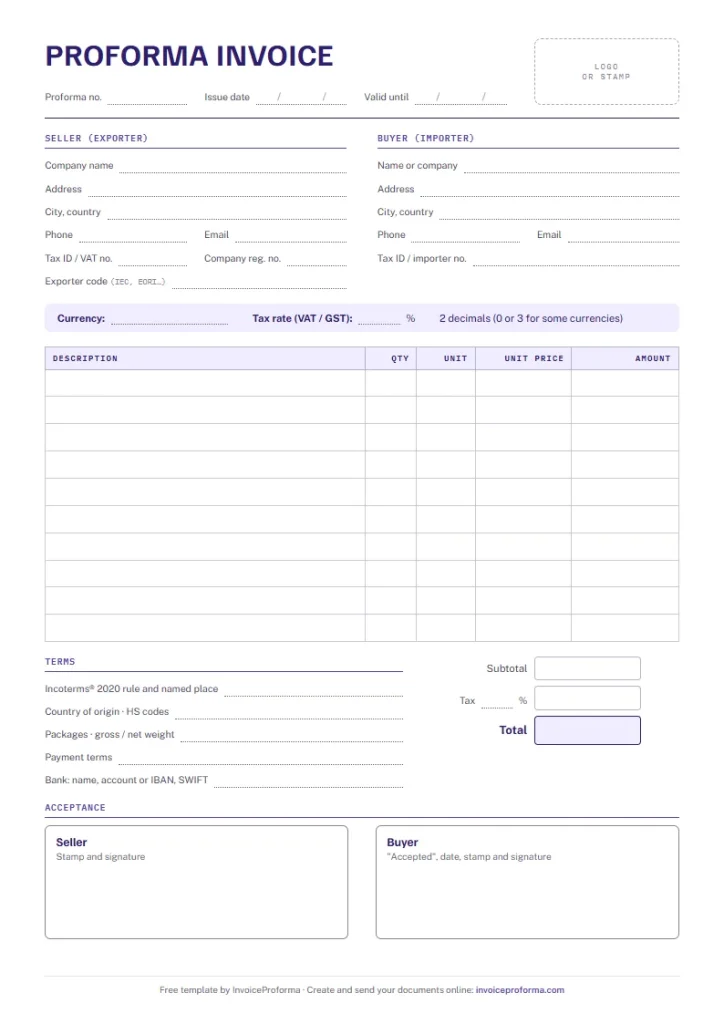
From the guide to the document
Your proforma with these details, ready as a PDF.
Before anything ships
1. Proforma invoice
Issued by you. The buyer uses it to open a letter of credit, obtain foreign exchange or apply for an import licence. It carries the goods description, HS codes, origin, Incoterms 2020 rule, validity and payment terms that every later document will repeat. See what a proforma invoice is.
2. Sale contract or accepted purchase order
A signed proforma often serves as the contract for straightforward shipments. For larger deals, put governing law, dispute resolution, force majeure, inspection rights and late-delivery consequences in a proper contract — the Incoterms rule covers none of those.
3. Export licence or authorisation, if required
Dual-use goods, defence articles, cultural property, certain chemicals, waste, endangered species (CITES) and encryption products need permits from your own authorities. Screening the buyer and end use against sanctions and denied-party lists belongs here too, not after loading.
The core commercial set
| Document | Issued by | Proves | Watch out for |
|---|---|---|---|
| Commercial invoice | Exporter | The sale, the value and the terms | Must match the credit and the proforma; state currency, Incoterms rule and named place, HS codes and origin |
| Packing list | Exporter | How the shipment is packed | Package count, marks and numbers, dimensions, gross and net weight must agree with the transport document |
| Bill of lading (sea) | Carrier or its agent | Receipt of goods, contract of carriage, and — if negotiable — title | Original set (usually three), on-board notation, consignee and notify wording, freight prepaid or collect |
| Sea waybill | Carrier | Receipt and contract, but not title | Faster release; unsuitable when the goods must be sold in transit or a bank needs control |
| Air waybill | Airline or agent | Receipt and contract | Never a document of title; consignee is named, so control passes at once |
| CMR consignment note | Road carrier | Receipt and contract for road transport | Signed by the carrier on collection; keep the stamped copy as proof of export |
| Certificate of origin | Chamber of commerce or authorised body | Where the goods were made | Some destinations require legalisation by their embassy; the preferential forms are different documents |
| Insurance certificate | Insurer or broker | Cargo cover | Required under CIF and CIP; usually 110% of invoice value, in the invoice currency |
| Export declaration | Exporter or customs agent, to your own customs | That the goods legally left the country | Your proof of export for tax purposes; keep the discharge message or exit confirmation |
Preferential origin documents
A plain certificate of origin states where goods were made. A preferential document goes further: it claims a reduced or zero duty rate under a trade agreement, and it is only valid if the goods meet that agreement’s origin rules — often expressed as a change of HS heading or a maximum share of non-originating material value. Common instruments include EUR.1 movement certificates, invoice or origin declarations by registered exporters, ATR movement certificates for EU–Türkiye industrial goods, and the certificates used under regional agreements such as AfCFTA, COMESA, ASEAN and USMCA. Claiming preference without meeting the rule exposes your buyer to a retroactive duty demand, so verify before you sign — our guide to the certificate of origin explains how origin is actually determined.
Product and destination-specific documents
- Phytosanitary certificate — plants, timber, seeds, some foodstuffs. Issued by your national plant protection organisation.
- Veterinary or health certificate — animal products, meat, dairy, fish. Usually tied to an approved establishment number.
- Fumigation and ISPM 15 treatment — wooden pallets and crates must be heat-treated or fumigated and stamped.
- Dangerous goods declaration — IMDG for sea, IATA DGD for air, with correct UN number, packing group and labelling.
- Pre-shipment inspection certificate — several countries require inspection and a conformity certificate before shipment; Nigeria (SONCAP), Kenya (PVoC), Saudi Arabia (Saber/SASO) and Algeria are frequently encountered examples.
- Cargo tracking note — a number of West and Central African destinations require an electronic cargo tracking note obtained before the vessel sails; without it the goods can be fined or refused.
- Test reports and conformity marks — CE for the EU, UKCA for Great Britain, and equivalents elsewhere; keep the declaration of conformity and technical file available.
- Halal or kosher certificate — food and some cosmetics, for specific markets.
- Legalised documents — some Middle Eastern and North African markets still require invoices and certificates of origin stamped by their consulate.
Advance filings and destination formalities
Many customs administrations now demand data before the goods arrive, and some before they are even loaded. Ocean shipments to the United States require an importer security filing; the European Union and the United Kingdom operate entry summary declarations; Egypt runs an advance cargo information system that produces a clearance number the shipping documents must quote; Nigeria’s Form M and Kenya’s import declaration form must be opened before shipment. Ask your buyer, in writing, which pre-arrival formality applies and what number must appear on your documents — then put that reference on the invoice.
Consistency rules that prevent most problems
- One master source. Generate the commercial invoice, packing list and certificate application from the accepted proforma rather than retyping each one.
- Identical party names. Legal name, street, city and country spelled the same on every document, including the transport document.
- Identical goods description. If the credit says “combed cotton poplin 120 gsm”, so does every document.
- Weights that agree. Packing list gross weight equals the transport document gross weight; net weight is consistent across the set.
- Same Incoterms rule and named place everywhere — see the Incoterms 2020 guide.
- Same HS codes and origin on the invoice, the packing list header and the origin certificate — see the HS code guide.
- Dates in order. Invoice date on or before shipment date; insurance effective no later than shipment; certificates not issued after the transport document unless the credit allows it.
Printable checklist
- Proforma invoice accepted, signed and stamped by the buyer
- Payment secured: deposit received, or credit advised and checked
- Export licence and party screening completed
- Booking confirmed; cut-off dates noted against the latest shipment date
- Commercial invoice issued, matching the proforma line for line
- Packing list finalised with marks, numbers and weights
- Transport document collected, with on-board notation if required
- Certificate of origin obtained, legalised if the destination requires it
- Insurance certificate issued where the Incoterms rule requires cover
- Product certificates: phytosanitary, health, fumigation, dangerous goods, conformity
- Destination formalities: pre-shipment inspection, cargo tracking note, advance filing reference
- Export declaration lodged and exit confirmation archived
- Full set scanned and sent to the buyer before the originals travel
Start the set correctly: use a free proforma invoice template, or create the document online and convert it into the invoice when the goods are ready. If a letter of credit is involved, read the letter of credit guide first.
Requirements change and vary by product and destination. Treat this checklist as a starting point and confirm the current rules with your freight forwarder, your customs broker or the destination customs authority before shipping.
Read next
Related guides
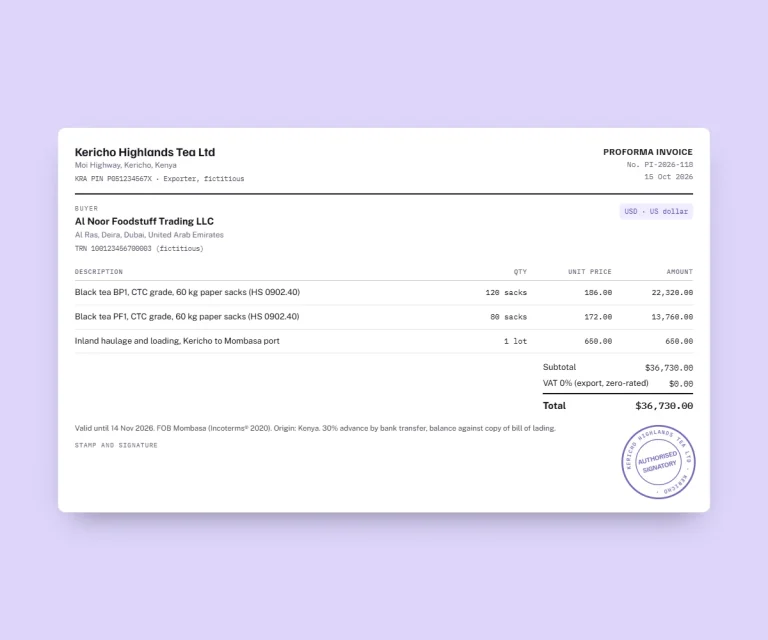
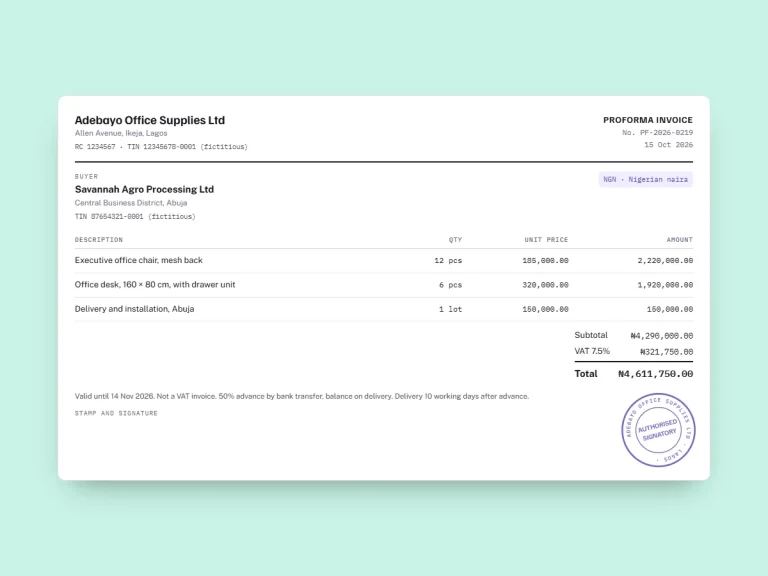
Three filled proforma invoice examples: an export from Kenya in US dollars, a GST proforma in India and a VAT proforma in Nigeria, every line explained.
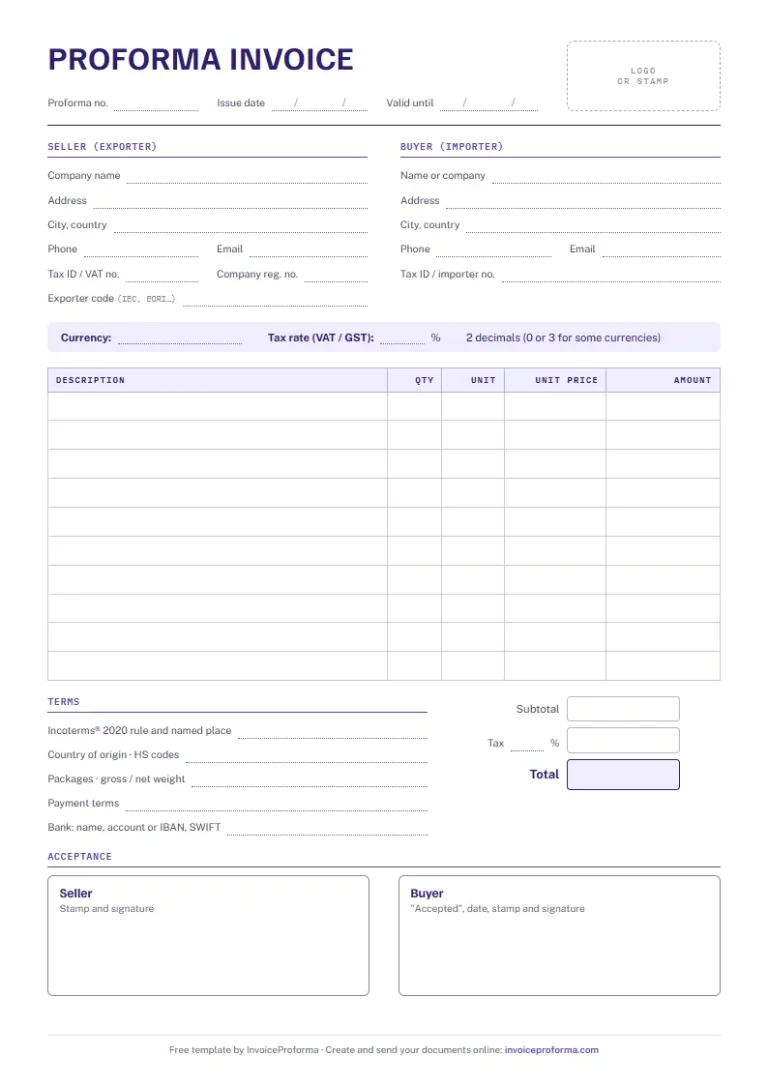
Non-preferential vs preferential origin, who issues the certificate, what it must match on your invoice, and the errors that trigger duty demands.
What the EU, US, Gulf, Nigeria, Kenya, North Africa and India expect before shipment: licences, exchange control and pre-shipment inspection.
Six documents, one app
From the quote to the receipt
One customer file, one product list and your own layout serve all six documents. An accepted quote or proforma becomes an invoice without retyping.
1. The price
Quote
QUO-2026-0012
Your price for the job, with a validity date and space for the buyer to accept it.
2. The firm offer
Proforma invoice
PI-2026-042
What your buyer’s bank, their forwarder or their purchasing team asks for before the order.
3. The order
Purchase order
PO-2026-0007
What is ordered, how many and for which delivery date, signed by the buyer.
4. The delivery
Delivery note
DN-2026-0007
It travels with the goods; the consignee signs it and writes down any reservation.
5. The sale
Invoice
INV-2026-0031
The accepted proforma or quote becomes the invoice, with the same lines and currency.
6. The payment
Payment receipt
REC-2026-0019
Proof of a payment, linked to its invoice, with the method and the balance still due.
3 free documents to try it, no card required.
Your next proforma invoice, already in your colours
Three free documents, no card required. Your tax IDs, bank details and payment terms are typed once, then printed on every PDF.